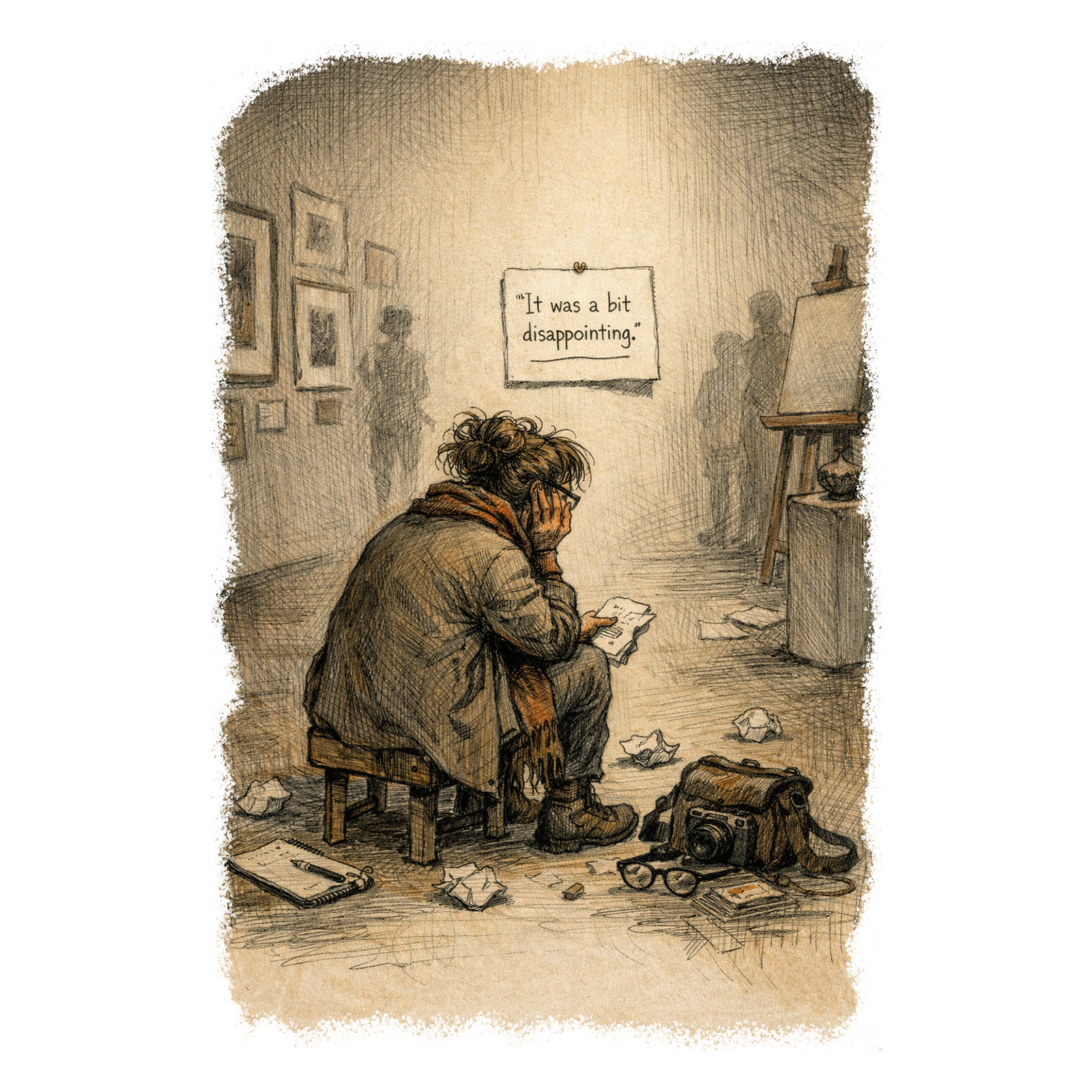
You can receive fifty kind comments.
Thoughtful ones.
Detailed ones.
Messages that say, “This moved me.”
Reviews that use words like powerful, honest, important.
And then there’s the one.
The single line that reads slightly colder than the rest.
Or blunt.
Or dismissive.
And somehow that’s the one your brain bookmarks.
One bad review is disproportionately loud.
I’ve stood in exhibitions where the majority response was warm. Conversations engaged. People leaning in. Quiet reflection.
Then later, someone writes something mildly critical.
Not abusive. Not outrageous.
Just… underwhelmed.
And suddenly my internal courtroom opens.
Exhibit A: That comment.
Exhibit B: Their tone.
Exhibit C: Possible hidden meanings.
I analyse reviews like evidence in court.
What did they mean by that?
Was that sarcasm?
Are they right?
Did I miss something obvious?
It’s almost impressive how forensic the mind becomes.
Catastrophic thinking doesn’t require drama.
It requires imagination.
You read one critique and your brain fast-forwards.
What if others think that too?
What if I’ve misjudged this entirely?
What if this damages credibility?
It escalates quickly.
Especially when your work is public.
Exhibitions are not private drafts.
They are open.
Anyone can walk in. Anyone can comment.
And when you choose to make work visible, you choose exposure.
I knew that intellectually.
Emotionally is different.
The emotional core here is personal sting.
Even measured feedback can feel personal when the work carries part of you.
If I were photographing something neutral, maybe it would land differently.
But when you’ve invested time, care, and emotional presence — especially in social impact work — criticism can feel like rejection of more than composition.
It can feel like rejection of intention.
That’s where catastrophic thinking hooks in.
I remember one specific review that wasn’t even harsh.
It simply questioned whether the exhibition could have gone deeper.
Objectively, that’s fair.
Subjectively, I spiralled.
Gone deeper?
Did I oversimplify?
Did I miss nuance?
Did I fail the people involved?
Within minutes, the review had grown larger in my mind than the dozens of affirming responses.
That’s negativity bias in action.
But knowing the psychology doesn’t immediately dissolve the feeling.
There’s also history involved.
When you’ve experienced seasons of being underestimated, dismissed, or not fully understood, critique can trigger older narratives.
See?
You’re not as solid as you thought.
You’ve been found out.
That’s not what the reviewer said.
It’s what the mind hears.
The courtroom analogy fits because I start building a case.
Re-reading the comment.
Looking for patterns.
Checking other reviews for corroboration.
As if I’m preparing a defence.
It’s exhausting.
One voice outweighing many.
Catastrophic thinking thrives in isolation.
You sit with the comment alone.
You don’t balance it with context.
You let it echo.
And echoes distort.
There’s also ego involved.
Not arrogance — attachment.
You want the work to be received well.
You want the stories to land respectfully.
So when someone critiques it, you interpret it as failure.
But critique is not condemnation.
It’s perspective.
The shift for me came slowly.
I started asking a different question.
Is there information here?
Not: Is this an attack?
Not: Does this invalidate everything?
Just: Is there information?
Sometimes there is.
Sometimes feedback highlights a blind spot.
An area for refinement.
A structural improvement.
And that’s valuable.
Other times, it’s simply taste.
Preference.
Expectation.
Not every review is a verdict.
It’s a viewpoint.
I had to separate identity from output.
Feedback is information, not identity.
That sentence is simple.
Living it is harder.
Because when you create publicly, the work feels personal.
But it’s not the entirety of you.
It’s an iteration.
A version.
A contribution.
Not a definition.
There’s humour in how dramatic my internal monologue can become over a single sentence.
I’ve genuinely paused mid-day and thought, “Should I change the entire approach because of this?”
Based on one comment.
That’s not strategy.
That’s insecurity reacting.
There was a turning point.
I received a piece of critique that, at first, felt sharp.
I stepped away.
Returned to it later.
Read it again calmly.
And realised something.
They weren’t attacking.
They were engaging.
They cared enough to offer perspective.
That reframing changed everything.
Critique means someone paid attention.
Indifference is quieter.
The purpose shift here is grounded.
Feedback is information.
It can refine craft.
It can sharpen clarity.
But it does not define worth.
If you treat every negative voice as proof of failure, you will hesitate to create.
If you treat feedback as data, you remain adaptable.
There’s also a practical element.
One bad review among many positive ones is not a trend.
It’s variance.
Patterns matter.
Isolated comments don’t.
Learning to zoom out is critical.
Look at the whole landscape, not the single pebble.
Exhibitions invite critique.
That’s part of visibility.
If you want impact, you accept response.
And response includes difference of opinion.
I’ve started responding to critique differently too.
Not defensively.
Not dismissively.
Just measured.
Thank you for the feedback. I appreciate you taking the time.
Because maturity in public spaces matters.
The internal sting may still appear briefly.
But it doesn’t dictate reaction.
The early part of my career was shaped by proving myself.
So critique felt like regression.
Now, it feels like calibration.
There’s a difference.
One bad review no longer defines the week.
It becomes one data point.
One perspective.
One opportunity to reflect.
And sometimes, to ignore.
Because not all feedback requires action.
Discernment is part of growth.
The catastrophic thinking still tries occasionally.
It still whispers, “What if this means more?”
But I’ve learned to answer it calmly.
It means someone had a view.
That’s all.
Feedback is information.
Not identity.
And identity built over years is not undone by one paragraph.
The courtroom closes.
The evidence is contextualised.
And the work continues.
Because stopping every time someone critiques would mean stopping constantly.
And growth doesn’t happen in silence.
It happens in visibility.
Even with one bad review.
Especially with one bad review.
How to find this article: