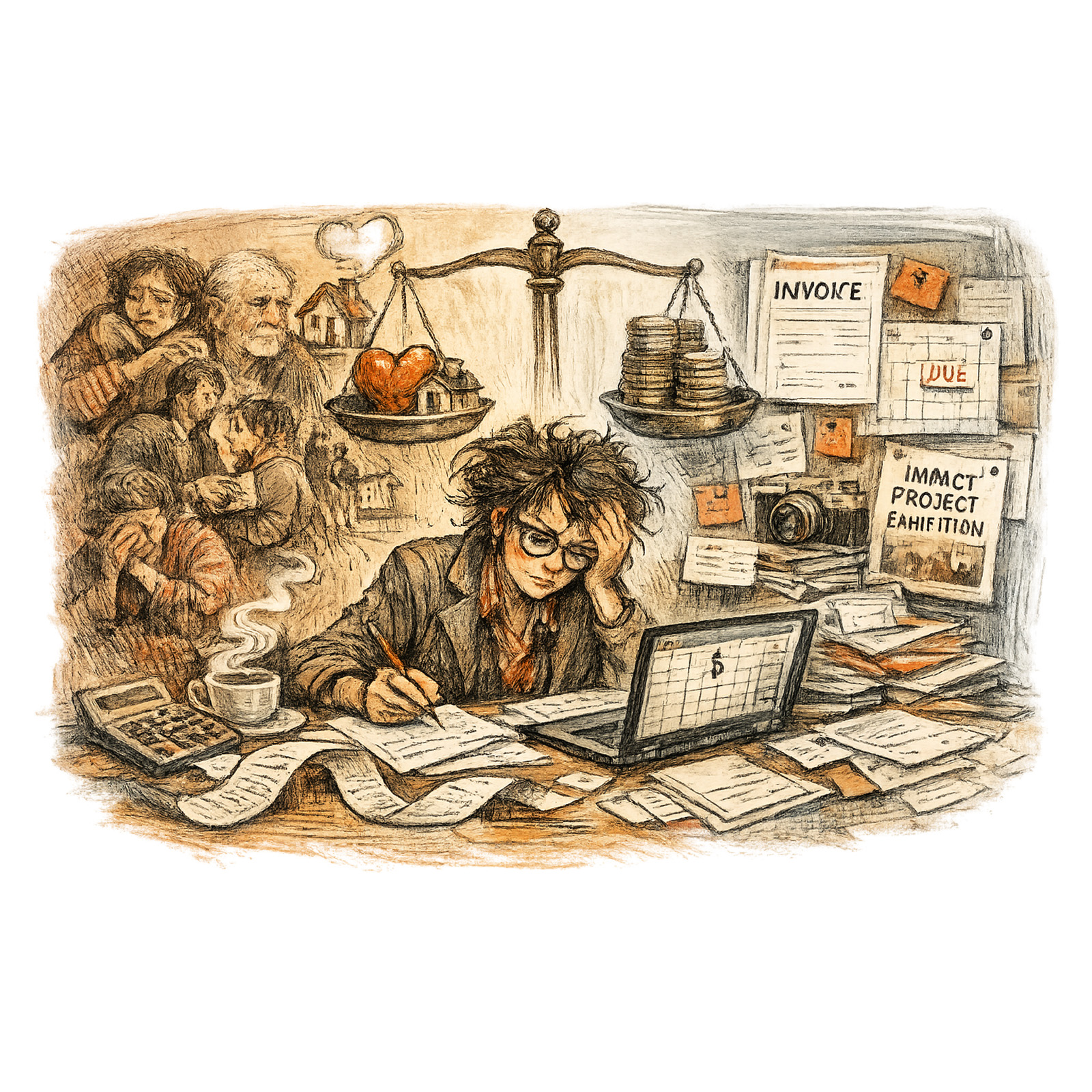
There’s a phrase I’ve caught myself saying more than once:
“It’s not about the money.”
Usually said with sincerity. Sometimes said while staring at a spreadsheet.
And here’s the uncomfortable truth.
It is not only about the money.
But it is not unrelated to the money either.
When your work sits at the intersection of social impact and business, you inherit a tension that doesn’t go away.
You’re telling stories about addiction.
About dementia.
About domestic abuse.
About homelessness.
You’re working with charities. Communities. Volunteers.
And somewhere in the background, there’s an invoice.
That can feel uncomfortable.
There’s a quiet creative martyr mindset that slips in easily in this space.
If the work is meaningful, it shouldn’t be profitable.
If the cause matters, money should be secondary.
If you care, you shouldn’t charge properly.
It sounds noble.
It’s also unsustainable.
The guilt of profit isn’t loud.
It’s subtle.
It shows up when a project goes well and you calculate the revenue attached to it.
It shows up when someone praises the impact and you think, “Yes… and also this is how I pay my mortgage.”
It shows up when you’re reviewing spreadsheets and catch yourself saying, almost defensively, “It’s not about the money.”
As if acknowledging financial structure somehow contaminates purpose.
That internal contradiction is exhausting.
I’ve built projects rooted in lived experience. I’ve collaborated with organisations where resources are stretched thin. I’ve sat in rooms with people who are volunteering their time out of sheer conviction.
And then I go home and run a business.
That dual identity can create friction.
Am I a storyteller or a service provider?
An advocate or an entrepreneur?
Purpose-driven or profit-aware?
The answer is both.
But for a long time, I behaved as if “both” was suspicious.
Because when you’ve known scarcity, when you’ve been on the receiving end of support, earning well within that same ecosystem can feel morally complex.
There’s a fear of appearing exploitative.
A fear of being perceived as leveraging stories for gain.
That fear matters.
It keeps you accountable.
But if it becomes dominant, it distorts decisions.
There were projects where I discounted heavily because charging fully felt uncomfortable.
There were proposals where I softened numbers because I didn’t want to seem transactional.
There were meetings where I emphasised impact so strongly that I downplayed sustainability.
Almost as if admitting the business side would undermine the mission.
That’s the creative martyr mindset.
If the work is pure, it should cost you something personally.
But here’s the reality.
It already costs something.
Time.
Energy.
Emotional capacity.
Opportunity cost.
Pretending it shouldn’t also provide financial return is not noble.
It’s destabilising.
There was a moment during a long-term awareness campaign where I realised something important.
The project was meaningful.
Deeply so.
It was also resource-intensive.
Travel, editing, coordination, printing, event planning.
If I had not structured it financially, it would have drained me.
And if it drained me, it would have ended.
Profit funds purpose.
That sentence took time to land properly.
Because the word profit carries baggage.
It sounds corporate.
Cold.
Detached.
But profit, in simple terms, is margin.
Margin is breathing space.
Margin is the ability to invest again.
Margin is the reason the next project exists.
Without profit, purpose becomes short-lived.
There’s comedy in the internal dialogue.
I’ve genuinely said, “It’s not about money,” while actively adjusting pricing models in a spreadsheet.
As if spreadsheets are morally questionable objects.
The reality is far less dramatic.
Spreadsheets allow continuity.
Continuity allows impact.
The emotional core here is contradiction.
You care deeply about people and stories.
You also care about keeping your lights on.
Those are not opposing values.
They are integrated ones.
But integration requires maturity.
In the early stages of building social impact projects, I overcompensated.
I wanted to be seen as purpose-first.
So I downplayed income structures.
I emphasised passion.
I avoided talking openly about financial models.
But the irony is that transparency builds trust.
When organisations understand that you are running a sustainable operation, they respect the structure.
When you treat your own work as economically fragile, others unconsciously do too.
There’s also a personal layer.
After rebuilding life post-2015, financial stability carried emotional significance.
It represented safety.
Consistency.
Structure.
Yet when stability began to form, I sometimes felt uneasy about it.
As if comfort might lead to complacency.
As if earning well might disconnect me from the urgency that once fuelled me.
That’s a flawed assumption.
Purpose does not require instability to remain sincere.
You do not need to struggle financially to care deeply.
In fact, financial pressure often narrows vision.
Stability expands it.
The shift for me was redefining what profit means in my context.
Profit is not excess.
It is reinvestment.
It funds better equipment.
Better printing.
Better event spaces.
More ambitious campaigns.
It funds time to think deeply instead of rushing to survive.
It funds collaboration without panic.
When I stopped viewing profit as a moral threat and started viewing it as structural support, something relaxed.
I could speak about pricing without apology.
I could build budgets without defensiveness.
I could articulate value clearly.
The guilt softened.
There’s still awareness.
I don’t ignore the ethical responsibility of working with sensitive stories.
But ethics and economics are not enemies.
They are partners.
If I want to tell stories long term, I need a business model that sustains that telling.
Creative martyrdom is romantic.
It is also short-lived.
Burnout often hides behind it.
“I’ll just do this one more unpaid project.”
“I’ll absorb the cost this time.”
“I’ll make it work somehow.”
That might be necessary occasionally.
But as a default strategy, it erodes sustainability.
The irony is that sustainable profit allows generosity.
When your business is stable, you can choose to offer work pro bono strategically.
You can support initiatives without destabilising yourself.
You can create space for impact without sacrificing longevity.
That’s strength, not compromise.
There’s another layer to the guilt of profit.
Public perception.
You worry that if people see financial success attached to social impact work, they’ll question motives.
But motives are visible in process.
In how you collaborate.
In how you credit others.
In how you represent stories.
In how transparent you are.
Profit does not automatically equal exploitation.
Intent and structure determine that.
I’ve learned to say something different now.
Instead of “It’s not about the money,” I say:
“The money allows the work to continue.”
That feels more honest.
Because I do care deeply about impact.
And I also care about sustainability.
The internal contradiction eases when you stop framing purpose and profit as opposites.
They are not.
Purpose without profit burns out.
Profit without purpose feels hollow.
Integrated well, they strengthen each other.
The spreadsheets still exist.
The invoices still go out.
The exhibitions still launch.
And the stories still matter.
Nothing about financial structure diminishes the weight of a conversation about dementia.
Nothing about profit reduces the care taken in documenting addiction recovery.
If anything, stability enhances presence.
You’re not distracted by survival.
You’re focused on quality.
The guilt of profit fades when you recognise that you are not exploiting stories.
You are building platforms for them.
And platforms require resources.
The martyr mindset whispers that you must suffer to be sincere.
That’s not true.
Sincerity is visible in how you work, not in how little you earn.
Profit funds purpose.
And purpose deserves to last.
Not just flare briefly and disappear.
So yes, I still review spreadsheets.
And yes, I still care deeply about impact.
Those two realities coexist.
Not in contradiction.
In alignment.
How to find this article: