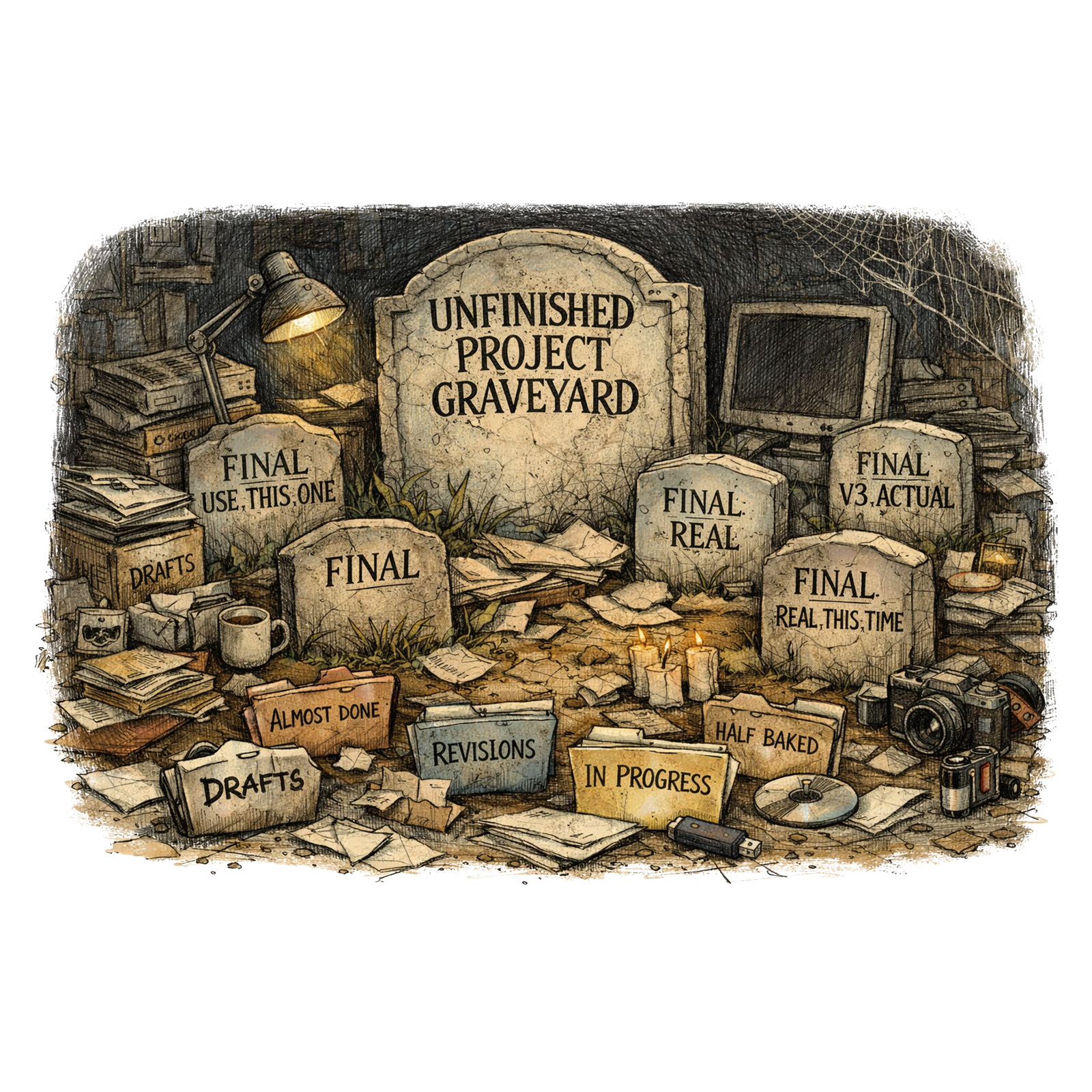
If you opened my hard drive without context, you might assume I run a small digital cemetery.
Folders everywhere.
Carefully labelled.
Optimistically titled.
Emotionally abandoned.
Some are called things like:
FINAL_USE_THIS_ONE
FINAL_REAL
FINAL_REAL_THIS_TIME
FINAL_V3_ACTUAL
You’d think by version four something would have been exported.
It usually hasn’t.
Welcome to the Unfinished Project Graveyard.
This isn’t about laziness.
It’s about doubt.
There’s a particular kind of doubt that appears halfway through meaningful work.
Not at the beginning — the beginning is energising.
Ideas are alive there. Conversations are fresh. Vision is clear.
The doubt arrives mid-project.
When the excitement settles and responsibility deepens.
Most of my long-term collaborative awareness campaigns start with clarity.
I know why we’re doing it.
I know who it’s for.
I know what it could become.
Then the material builds.
Interviews stack up.
Portraits accumulate.
Transcripts grow heavier.
And somewhere in the middle, I start asking a dangerous question:
Am I doing this justice?
That question sounds noble.
It feels responsible.
It can also paralyse you.
Because when the subject matter is heavy — domestic abuse, dementia, addiction, social exclusion — the stakes feel higher.
You’re not designing a lifestyle shoot.
You’re representing lived experience.
Someone has trusted you with something personal.
Finishing suddenly feels weighty.
What if I get the tone wrong?
What if the edit flattens nuance?
What if the layout diminishes their voice?
Meaningful work feels heavier to complete.
You’re not just finishing a project.
You’re finalising someone’s story in a public form.
That weight slows you down.
I’ve had projects stall not because they lacked quality, but because they carried significance.
I’d open the folder.
Scroll.
Rearrange sequences.
Adjust captions.
Rename the document again.
FINAL_THIS_ONE_TRUST_ME.
Close it.
The unfinished project graveyard isn’t filled with bad ideas.
It’s filled with almost-ready courage.
Mid-project doubt is uniquely exhausting.
At the start, energy is high.
At the end, momentum returns.
In the middle, you sit in ambiguity.
You’ve invested time.
You’ve gathered material.
You’ve promised outcomes.
But you’re not yet certain it lands the way you intended.
That’s the emotional core.
Fear of not doing justice to someone’s story.
It’s one thing to hesitate over a personal art piece.
It’s another to hesitate over work rooted in real people’s lived experience.
Because if you misrepresent your own idea, you adjust.
If you mishandle someone’s narrative, you feel it deeply.
So you refine.
And refine.
And refine.
Sometimes into stagnation.
There was one collaborative awareness campaign that sat in development longer than it should have.
All the components were there.
Portraits completed.
Stories recorded.
Structure mapped.
But I kept revisiting small elements.
The sequencing.
The phrasing.
The image selection.
Convincing myself it wasn’t quite ready.
Underneath that wasn’t perfectionism about aesthetics.
It was fear.
Fear that I’d oversimplified complexity.
Fear that I hadn’t captured enough nuance.
Fear that I’d failed someone’s trust.
Those fears are not irrational.
They’re responsible concerns.
But responsibility must eventually turn into release.
Unfinished work serves no one.
The people who shared their stories don’t benefit from a beautifully organised folder on my desktop.
They benefit from visibility.
From conversation.
From completion.
The graveyard grows quietly.
Not because I forget projects.
Because I hesitate to finalise them.
I’ve caught myself reopening old campaign files months later, reading through transcripts again as if looking for a hidden flaw I missed.
Sometimes there isn’t one.
There’s just discomfort.
Discomfort with the fact that meaningful work can never feel entirely finished in your head.
You will always see ways it could be expanded.
More interviews.
More context.
More depth.
But at some point, more becomes avoidance.
There’s also something protective about unfinished work.
If it’s not published, it can’t be criticised.
If it’s not exhibited, it can’t be misunderstood.
If it’s not printed, it can’t be challenged.
Unfinished work remains potential.
And potential feels safer than exposure.
But potential doesn’t create change.
There was a turning point for me on one campaign.
I was mid-edit, again, rearranging captions for the fifth time.
And I realised something uncomfortable.
The project was ready.
I wasn’t.
Ready to release it.
Ready to let it stand without further polishing.
Ready to accept that I had done my best within reasonable boundaries.
That’s the shift.
You don’t wait until the project feels flawless.
You release when it feels honest.
Finished imperfect work serves more than unfinished perfect ideas.
That sentence feels almost too simple.
But it’s true.
An imperfectly structured exhibition still sparks conversation.
A slightly awkward caption still amplifies a voice.
A campaign that isn’t exhaustive still opens dialogue.
An unfinished campaign does nothing.
The people I collaborate with aren’t expecting cinematic perfection.
They’re expecting respect.
Accuracy.
Care.
Those are achieved through attention, not endless delay.
The humour in the file names helps me see the pattern.
FINAL_REAL_THIS_TIME.
As if renaming the document increases its courage.
It doesn’t.
Courage is clicking export.
Courage is sending it to print.
Courage is announcing the launch date.
Courage is letting it exist outside your control.
Mid-project doubt will always appear.
Especially when the work matters.
If the work didn’t matter, you wouldn’t hesitate.
But hesitation must have a deadline.
Otherwise it becomes a habit.
I’ve started implementing simple rules.
When structure is clear and feedback has been sought, set a release date.
Publicly.
Tell collaborators.
Commit to it.
Deadlines convert fear into action.
Because at some point, responsibility shifts from refinement to delivery.
The graveyard still exists.
There are still folders I revisit occasionally.
But fewer.
Because I’ve learned that protecting stories doesn’t mean guarding them indefinitely.
It means completing them thoughtfully.
There’s another subtle truth here.
Finishing a project doesn’t mean you’ve captured the entire issue.
No exhibition, no book, no campaign can hold the full weight of domestic abuse, dementia, addiction, or social inequality.
They are vast.
Your role is not to encapsulate everything.
Your role is to contribute something.
Once I accepted that, the pressure eased.
I’m not producing definitive statements.
I’m facilitating conversation.
And conversation requires presence, not perfection.
The unfinished project graveyard taught me something valuable.
Doubt mid-project is not a sign to abandon.
It’s a sign you care.
But care must transition into courage.
Otherwise it calcifies into stagnation.
Now when I open a folder labelled FINAL_V4_ACTUAL, I ask a different question.
Is this honest?
Is this respectful?
Is this ready enough to serve?
If the answer is yes, I finish it.
Not because it couldn’t be refined further.
Because it deserves to live.
And the people within it deserve to be seen.
Imperfectly, perhaps.
But visibly.
Finished work moves.
Unfinished work waits.
And meaningful work deserves to move.
How to find this article: