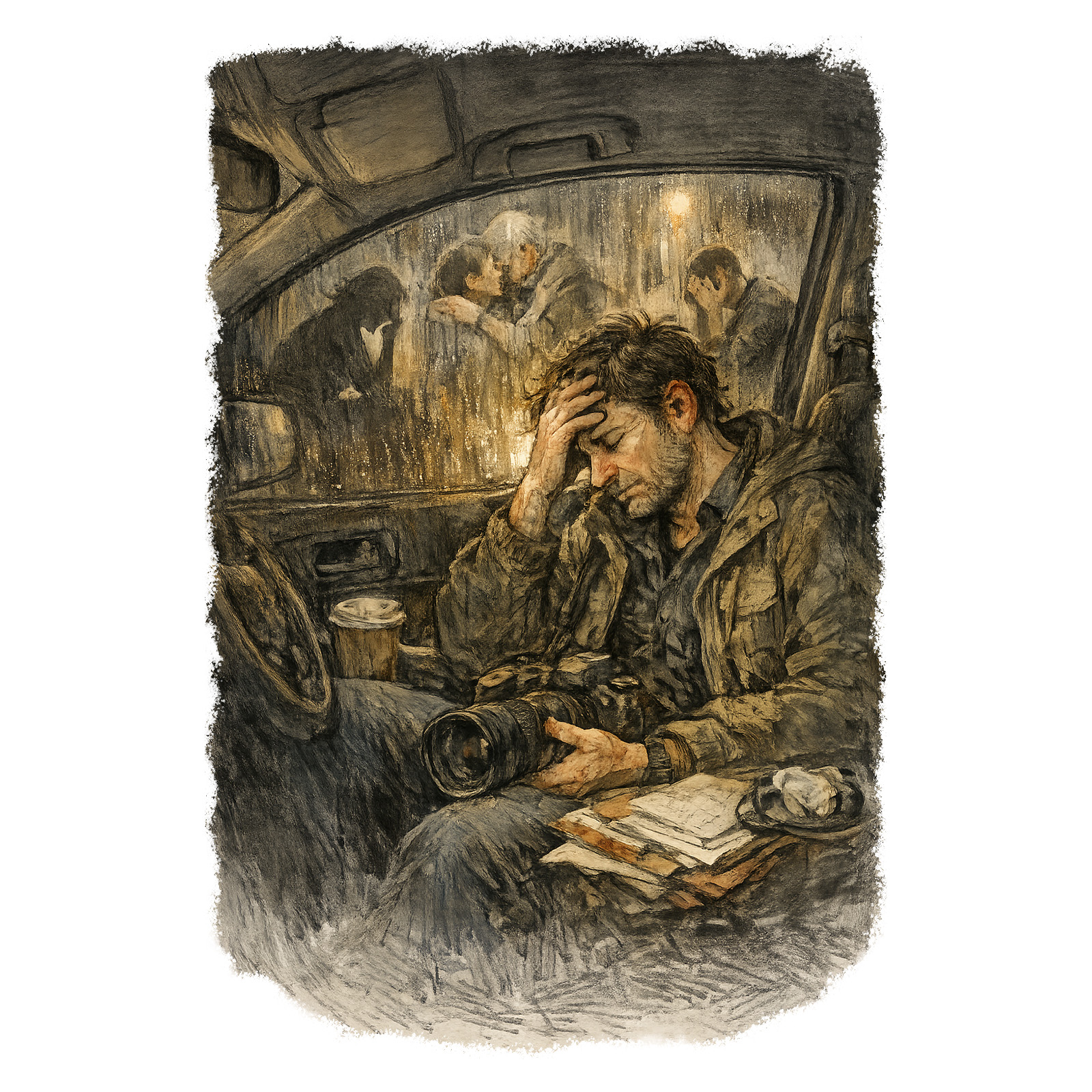
There’s a myth that photography is objective.
That you stand behind a camera, observe, document, and go home untouched.
That if you keep a professional distance, the stories pass through you without settling.
That is not my experience.
I have stood in rooms where people have told me about domestic abuse in calm, almost clinical tones.
I have listened to families describe dementia stealing memories inch by inch.
I have photographed individuals navigating addiction recovery with a mixture of pride and fragility in their eyes.
And then I have driven home in silence.
Documentary work is not emotionally neutral.
You don’t just frame light.
You absorb atmosphere.
You don’t just record words.
You carry weight.
I didn’t realise how much at first.
Early on, I treated it like any other assignment. Prepare well. Listen carefully. Capture honestly. Deliver respectfully.
And I did.
But what I didn’t account for was residue.
Conversations don’t evaporate when you pack your gear away.
They linger.
There’s something about being entrusted with someone’s lived experience that shifts your posture.
You’re not just producing images.
You’re holding vulnerability.
When someone speaks about domestic abuse, they’re not narrating statistics. They’re recalling moments. Tone shifts. Pauses lengthen. Hands move differently.
You see it.
You feel it.
And because I’ve had my own chapters of instability and rebuilding, there’s recognition.
Not identical experience.
Recognition.
That recognition deepens empathy.
It also deepens absorption.
I’ve caught myself mid-portrait blinking harder than necessary.
Blaming tears on dust.
“It’s just the light,” I’ll say casually.
As if overhead lighting is particularly emotional that day.
There’s humour in that.
But it masks something real.
When someone trusts you with their story, you don’t leave it neatly folded in the corner of the room.
You take it with you.
I remember one interview with a woman sharing her journey through domestic abuse.
Her tone was steady. Controlled. Almost composed.
But the pauses were heavy.
And as she spoke, I found myself not just listening as a photographer.
I was listening as a human who understands what it feels like to lose footing.
To rebuild.
To carry history quietly.
After the session, I packed up carefully.
Said thank you.
Drove home.
And felt unusually quiet.
Not sad.
Weighted.
That’s the emotional core of this chapter.
Deep empathy with memory.
When someone speaks about addiction cycles, about relapse, about shame, about the fragile pride of recovery, something in me doesn’t treat it as abstract.
It lands differently.
Because I understand what it feels like to rebuild identity.
To step forward cautiously.
To not want to waste a second chance.
So when someone speaks about those themes, I don’t observe from distance.
I relate from depth.
And depth is not light.
There’s a danger in emotional absorption.
It can look noble.
“I care deeply.”
But without boundaries, care becomes exhaustion.
I’ve had weeks where I’ve moved from one heavy story to another.
Dementia in the morning.
Addiction in the afternoon.
Family strain in the evening.
Each conversation important. Each person deserving full attention.
But attention costs energy.
There were days where I’d sit at my desk after a series of interviews and feel slightly hollow.
Not because the work lacked meaning.
Because it held too much.
When you carry heavy stories repeatedly, you have to be intentional about where you set them down.
I didn’t always do that well.
Early on, I’d finish a session and immediately start editing.
Immersing myself further.
Listening again. Watching again. Reading transcripts.
Layering exposure on exposure.
That’s not resilience.
That’s saturation.
The comedy of it is that I sometimes try to behave as if I’m unaffected.
Professional. Composed. Balanced.
Then I’ll find myself unusually quiet at dinner.
Or distracted.
Or thinking about a conversation from three days ago.
And someone will ask, “You okay?”
And I’ll say, “Yeah, just tired.”
Which is partly true.
But it’s not just tired.
It’s full.
There’s a particular weight that comes from photographing dementia narratives.
Watching someone speak about a parent slowly losing recognition.
Hearing the tenderness and frustration coexist.
When you document that, you don’t just record it.
You witness it.
Witnessing is intimate.
It requires presence.
And presence is emotionally expensive.
The temptation is to either detach completely or over-identify.
Neither works.
Detachment strips the work of empathy.
Over-identification strips you of energy.
The balance is deliberate.
Boundaries are not indifference.
They are protection.
There was a period where I realised I was thinking about subjects late at night.
Replaying phrases.
Imagining alternate outcomes.
Carrying scenarios beyond my role.
That’s when I understood something important.
I am a witness.
Not a saviour.
That distinction matters.
I cannot fix systemic issues through a lens.
I cannot resolve someone’s trauma by documenting it carefully.
I can honour it.
I can represent it truthfully.
I can amplify it responsibly.
But I cannot carry it indefinitely.
When you care deeply about impact, it’s easy to blur that line.
You want your work to matter.
You want it to create change.
And when the stories are heavy, you want relief for the people telling them.
But you must separate responsibility from compassion.
Responsibility says: do your role well.
Compassion says: care.
Over-responsibility says: carry everything.
That’s not sustainable.
I’ve learned to build small rituals after heavy sessions.
Not dramatic ones.
Simple decompression.
A walk.
Silence in the car without replaying audio.
Time before opening the laptop again.
Letting the story settle without immediately re-entering it.
Because if you don’t set it down intentionally, it follows you.
I’ve also learned that humour has a place.
Not about the subject matter.
But about myself.
When I catch myself blaming tears on “dust,” I smile at the absurdity.
Because acknowledging the weight is healthier than pretending immunity.
Documentary work is not emotionally neutral.
It shapes you.
It deepens you.
It challenges you.
But it must not consume you.
The purpose shift for me has been this:
Boundaries preserve impact.
If I burn out emotionally, the work suffers.
If I become numb, the work suffers.
If I absorb every story without protection, I lose clarity.
The goal is not to feel nothing.
The goal is to feel responsibly.
To engage fully in the moment.
To listen with empathy.
To photograph with care.
And then to release.
Release the parts that are not mine to hold.
I carry heavy stories.
But I do not carry them alone, and I do not carry them indefinitely.
I honour them.
I document them.
I respect them.
And then I return to steadiness.
Because steadiness allows me to keep showing up.
And showing up consistently is more valuable than collapsing under the weight of meaning.
Dust in the eye.
That’s the joke.
But the truth is deeper.
Empathy is strength.
Boundaries are wisdom.
And both are necessary if the work is going to last.
How to find this article: