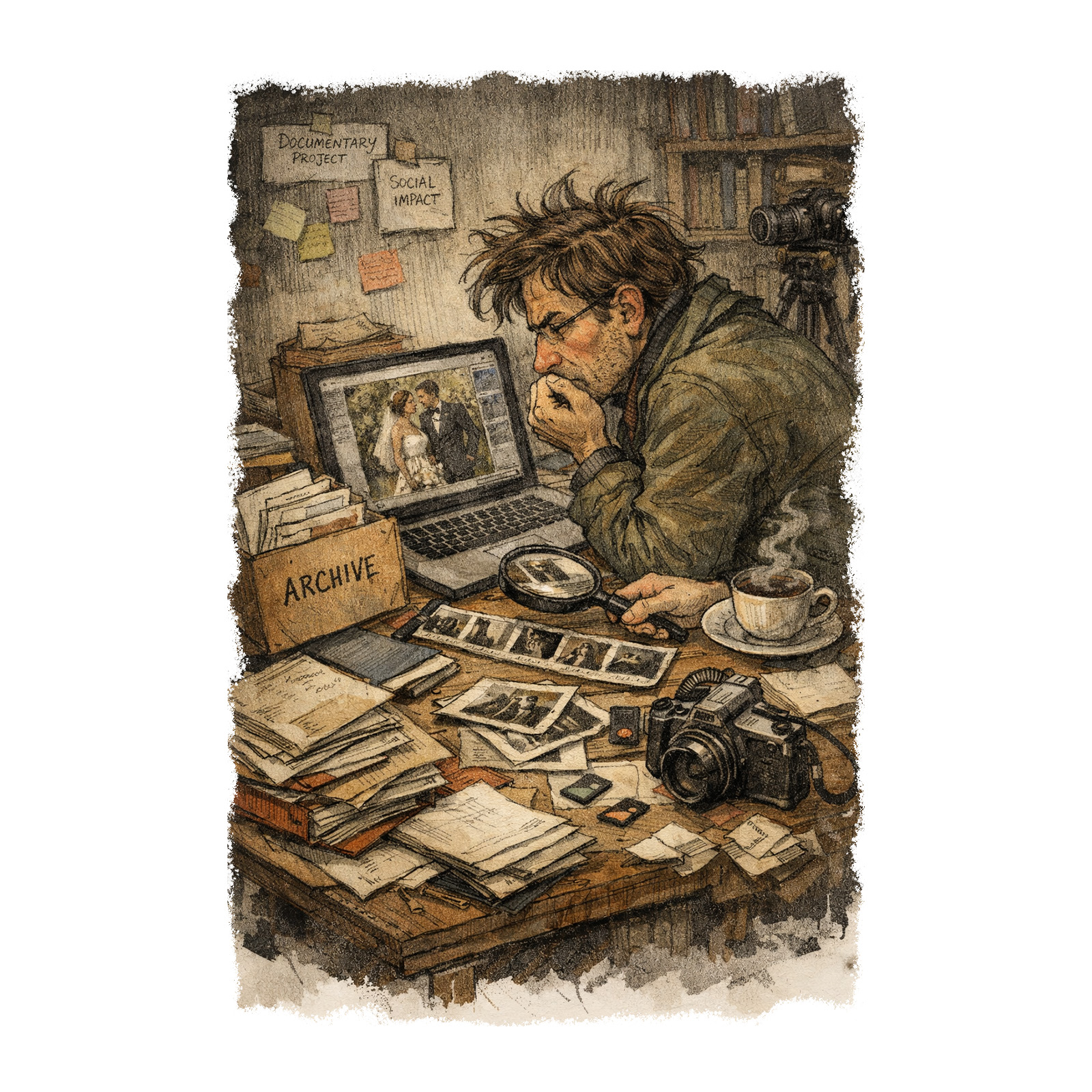
There is a very dangerous folder on my hard drive.
It’s called “Archive.”
Inside it live older wedding galleries. Early exhibitions. Projects that felt sharp, confident, decisive.
Every so often — usually when I’m in the middle of something new and slightly uncomfortable — I open it.
Not casually.
Suspiciously.
I scroll through old RAW files like I’m checking evidence.
Was I better then?
It’s an absurd question on the surface. But it doesn’t feel absurd in the moment.
Creative decline is a fear that sneaks in quietly.
It doesn’t say, “You’re finished.”
It says, “You peaked.”
Subtle difference. Same damage.
When I began transitioning from primarily weddings into more social impact projects — longer-term documentary work, community collaborations, exhibitions rooted in lived experience — something shifted.
The pace changed.
The feedback loop changed.
The visible metrics changed.
Weddings are immediate.
You shoot.
You deliver.
You receive response.
You move on.
There’s rhythm. Energy. Clear structure.
Documentary and social impact work is slower.
You listen more.
You wait more.
You carry stories longer.
You sit with complexity.
It doesn’t always produce instant applause.
It often produces depth.
And depth is harder to measure.
In the middle of that transition, I started feeling something uncomfortable.
A wobble.
Not dramatic.
Just the faint question:
Are you losing your edge?
It’s strange how growth can feel like regression.
When you change direction, you temporarily lose fluency.
You’re not the beginner, but you’re not fully established in the new space either.
You’re in-between.
And in-between is uncomfortable.
I remember editing a documentary portrait one evening and thinking, “This doesn’t feel as sharp as that wedding from 2018.”
Which is ridiculous.
Different context.
Different intention.
Different emotional weight.
But the brain doesn’t always compare fairly.
It compares emotionally.
And emotionally, weddings had been a space of confidence for years.
I knew how to navigate them.
I understood timing instinctively.
I could anticipate moments.
Shifting into deeper, slower storytelling required a different muscle.
And when that muscle isn’t fully developed yet, doubt fills the gap.
That’s when the archive folder becomes tempting.
I’ve genuinely opened old RAW files just to reassure myself.
Zooming into past images.
Look at that composition.
Look at that light.
See? You could do this.
It’s half encouragement, half interrogation.
Creative insecurity has a very particular tone.
It doesn’t accuse loudly.
It questions quietly.
Are you slipping?
Have you drifted too far?
Was that season your peak?
The emotional core of this chapter is doubt during evolution.
Evolution rarely feels smooth from the inside.
From the outside, people might say, “Your work has grown.”
Inside, you feel awkward.
Learning again.
Adjusting.
Stretching.
Stretching feels like weakness before it feels like strength.
There’s a comfort in staying where you’re fluent.
In a familiar style.
In a predictable rhythm.
In a space where you know you perform well.
Growth disrupts fluency.
It demands risk.
It introduces temporary incompetence.
And if you’ve worked hard to build confidence, temporary incompetence feels threatening.
Especially when your career has already included rebuilding from scratch once.
You don’t want to start again.
You don’t want to feel uncertain.
So you ask yourself, “Was I better last year?”
What that question is really asking is:
Was I safer last year?
Safer in skill.
Safer in reputation.
Safer in direction.
When I was deep in wedding seasons, my confidence was rooted in repetition.
I’d done it hundreds of times.
I could move through a day instinctively.
Transitioning into social impact projects required vulnerability.
Longer conversations.
Heavier themes.
Less immediate feedback.
You don’t get applause mid-interview about addiction or domestic abuse.
You get silence.
Processing.
Sometimes tears.
That’s not the same high.
It’s deeper.
But depth doesn’t always feel like progress.
It feels weighty.
I noticed that during this transition, I was harsher on myself.
I scrutinised images more.
Questioned decisions more.
Compared outputs more frequently.
Not because the work was weaker.
Because it was different.
Difference can masquerade as decline if you’re not careful.
I had to confront something uncomfortable.
If I wanted to grow, I had to accept a temporary dip in confidence.
Not skill.
Confidence.
They’re not the same.
Skill builds through practice.
Confidence fluctuates with context.
When you enter new territory, confidence lags behind capability.
That’s normal.
But it doesn’t feel normal.
It feels like slipping.
There was a particular week where I genuinely considered whether I’d overcomplicated my path.
You were doing well.
Weddings were consistent.
Why pivot?
Because purpose evolved.
Because the stories mattered.
Because I wasn’t interested in standing still creatively.
But purpose-driven pivots are still pivots.
They destabilise familiarity.
And familiarity is comforting.
Opening those old RAW files became less about reassurance and more about perspective.
I started noticing something interesting.
The earlier work I admired had its own imperfections.
Moments slightly missed.
Frames slightly rushed.
Compositions not as balanced as memory suggested.
Memory edits generously.
It polishes the past.
It removes doubt from earlier chapters.
But those earlier chapters had their own insecurities.
I just don’t remember them as vividly.
Progress rarely feels comfortable in real time.
It feels uncertain.
It feels slightly exposed.
It feels like you’re risking reputation for growth.
The trap is interpreting discomfort as decline.
When in fact, discomfort often signals expansion.
I had to reframe the question.
Instead of asking, “Was I better last year?” I started asking, “Am I braver this year?”
Bravery looks different.
It might look like tackling heavier themes.
It might look like stepping into new collaborations.
It might look like accepting that growth includes awkward phases.
Evolution includes seasons where you don’t feel as sharp.
That doesn’t mean you’ve regressed.
It means you’re stretching.
If you only measure yourself against your most fluent season, you will always feel like you’re losing something when you change.
But change is the point.
Stagnation feels comfortable.
It also flattens over time.
I don’t want to be the photographer I was five years ago.
I want to be more thoughtful.
More nuanced.
More grounded.
That requires discomfort.
The archive folder still exists.
I still occasionally open it.
But now it serves a different purpose.
Not to compare.
To contextualise.
To remind myself that every season once felt uncertain.
That confidence I associate with earlier years was built slowly too.
I just forget the early wobble.
Growth feels like regression mid-transition because you haven’t fully integrated the new skill set yet.
You’re halfway up a ladder looking down at the rung you left and up at the rung you haven’t reached.
Halfway feels unstable.
But it’s progress.
The purpose shift for me was simple but difficult to internalise:
Progress rarely feels comfortable.
If it feels entirely safe, you’re probably repeating yourself.
If it feels slightly uncomfortable, you’re likely evolving.
So when the question creeps in now — “Were you better last year?” — I answer it differently.
I was different last year.
And different is the point.
Because standing still to protect confidence is not growth.
It’s preservation.
And I didn’t rebuild my life to preserve.
I rebuilt it to expand.
Even if expansion feels uncertain for a while.
Especially then.
How to find this article: