There’s a very convincing lie that sounds responsible.
It says, “Work harder.”
It doesn’t shout. It doesn’t panic. It sounds mature. Disciplined. Driven.
Work harder. Don’t waste this. Keep going.
After 2015, after rehab, after rebuilding structure piece by piece, that voice was loud.
Not chaotic.
Focused.
You’ve been given a second chance.
Don’t mess it up.
Don’t waste it.
Don’t drift.
There’s something powerful about a second chance.
It sharpens you.
It clears nonsense quickly.
It makes you grateful for ordinary days.
But it can also make you relentless.
Relentless in a way that looks admirable from the outside.
Say yes to the wedding.
Say yes to the community project.
Say yes to the collaboration.
Say yes to the talk.
Say yes to the book idea.
Say yes to the extra edit.
Say yes because who knows when it might slow down again.
That’s the hidden engine.
Not ambition alone.
Fear of falling back.
When you’ve experienced instability, you develop a reflex.
Keep moving.
If you slow down, you slip.
If you hesitate, you lose ground.
So you build momentum like your life depends on it.
In some ways, that’s what helped me.
I worked hard.
I showed up.
I learned quickly.
I didn’t treat the camera casually.
I treated it like it mattered.
Because it did.
But somewhere along the way, hustle stopped being strategy and started being identity.
I wasn’t just working hard.
I was proving something.
Proving that I deserved the stability I’d rebuilt.
Proving that I wasn’t going backwards.
Proving that this wasn’t temporary.
The irony of burnout is that it rarely announces itself clearly.
It doesn’t walk in and say, “Hello, I am exhaustion.”
It disguises itself as dedication.
You’re just committed.
You’re just ambitious.
You’re just making the most of opportunity.
I remember a stretch where my calendar was packed.
Weddings on weekends.
Editing late into evenings.
Planning exhibitions midweek.
Writing squeezed between client calls.
From the outside, it looked like growth.
Inside, it felt like obligation.
Not obligation to clients.
Obligation to my own history.
Don’t waste this.
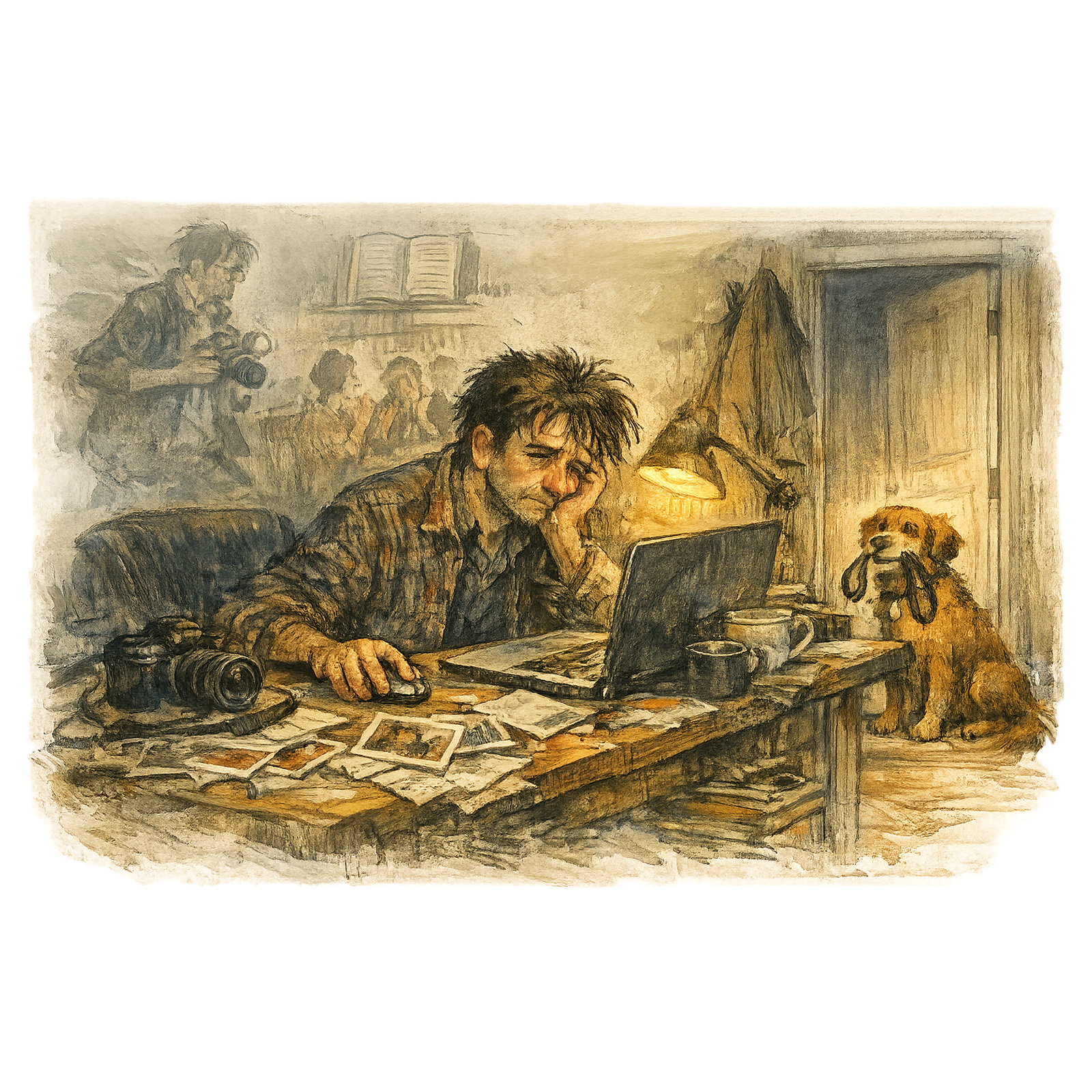
There were evenings where my dog would sit near the door, leash in his mouth, hopeful.
And I’d say, “Just ten minutes.”
Ten minutes became forty.
Forty became ninety.
He’d eventually wander off and lie down.
And I’d still be editing.
That image sticks with me.
Not because I feel dramatic guilt about it.
But because it shows something simple.
I had stopped distinguishing between meaningful work and compulsive work.
Compulsive work doesn’t come from joy.
It comes from fear.
Fear that if you’re not moving, you’re declining.
Fear that if you’re not visible, you’re fading.
Fear that if you say no, the opportunity disappears permanently.
When you’ve had seasons where opportunity felt scarce, saying no feels dangerous.
I said yes to projects I didn’t have space for.
Yes to timelines that were tight.
Yes to ideas that could have waited.
Not because they were all essential.
Because slowing down felt risky.
Burnout in disguise doesn’t feel like collapse at first.
It feels like momentum.
You power through.
You pride yourself on resilience.
You tell yourself you’re built for this.
And in many ways, I was resilient.
But resilience without rest becomes erosion.
It doesn’t crack suddenly.
It thins.
I started noticing small signs.
Irritability over minor things.
Struggling to focus deeply.
Feeling slightly detached from work I normally cared about.
Nothing dramatic.
Just a subtle dullness.
The emotional core of burnout isn’t drama.
It’s quiet exhaustion you don’t admit publicly.
Because publicly, everything looks fine.
Projects are progressing.
Exhibitions are planned.
Books are written.
You’re productive.
But productivity and sustainability are not the same thing.
There’s a moment I remember clearly.
I was sitting at my desk late, editing images from a project that genuinely mattered.
And instead of feeling connected to the work, I felt mechanical.
Click. Adjust. Export.
No frustration. No excitement.
Just process.
And I thought, “When did this start feeling like survival instead of expression?”
That question was uncomfortable.
Because the hustle had once saved me.
It had rebuilt structure.
It had given me direction.
But what begins as discipline can morph into compulsion if you don’t adjust it.
Post-rehab determination is powerful.
It carries intensity.
You don’t want to drift again.
You don’t want to squander stability.
So you equate rest with risk.
If I slow down, I slide.
That’s the false equation.
Rest is not regression.
But when your nervous system has been trained to respond to instability, it treats stillness with suspicion.
There’s a part of me that still occasionally thinks, “If you relax too much, it all disappears.”
That part is protective.
It helped once.
But it doesn’t get to set the pace anymore.
The shift for me came slowly.
Not through collapse.
Through awareness.
I started noticing that my best work wasn’t produced in frantic seasons.
It came from focused, balanced periods.
When I had space to think.
When I had margin.
When I wasn’t constantly trying to outrun an invisible threat.
I began experimenting with something that felt counterintuitive.
Saying no.
Not dramatically.
Strategically.
Spacing projects more realistically.
Protecting evenings.
Scheduling genuine downtime.
At first, it felt reckless.
Like I was tempting fate.
But something surprising happened.
Nothing collapsed.
Clients didn’t vanish.
Opportunities didn’t evaporate.
In fact, the work improved.
Because energy improved.
You don’t need to re-earn your place daily.
That sentence took time to believe.
When you’ve rebuilt something, you sometimes behave as if it’s on loan.
As if every day you must justify your presence.
But stability built over years doesn’t disappear because you take a weekend off.
Professional identity isn’t maintained by exhaustion.
It’s maintained by consistency.
Consistency requires sustainability.
Burnout in disguise whispers that your value is proportional to your output.
But value rooted in output alone is fragile.
There were seasons where I worked to prove.
Now I try to work from clarity.
Clarity that my place isn’t temporary.
Clarity that rest is not laziness.
Clarity that saying no can be responsible.
I still work hard.
That hasn’t changed.
But the motivation has shifted.
It’s no longer fear of falling back.
It’s commitment to moving forward wisely.
The difference is subtle but powerful.
One feels frantic.
The other feels steady.
When I see my dog now waiting by the door, I close the laptop.
Not because work isn’t important.
Because life isn’t a competition against your own past.
You don’t need to re-earn your place every day.
You earned it through showing up.
Through rebuilding.
Through persistence.
Now, the challenge isn’t proving worth.
It’s protecting it.
And protection sometimes looks like rest.
Not hustle.
Not urgency.
Just steady, sustainable work.
Without the fear that if you pause, everything disappears.
Because it won’t.
Not anymore.