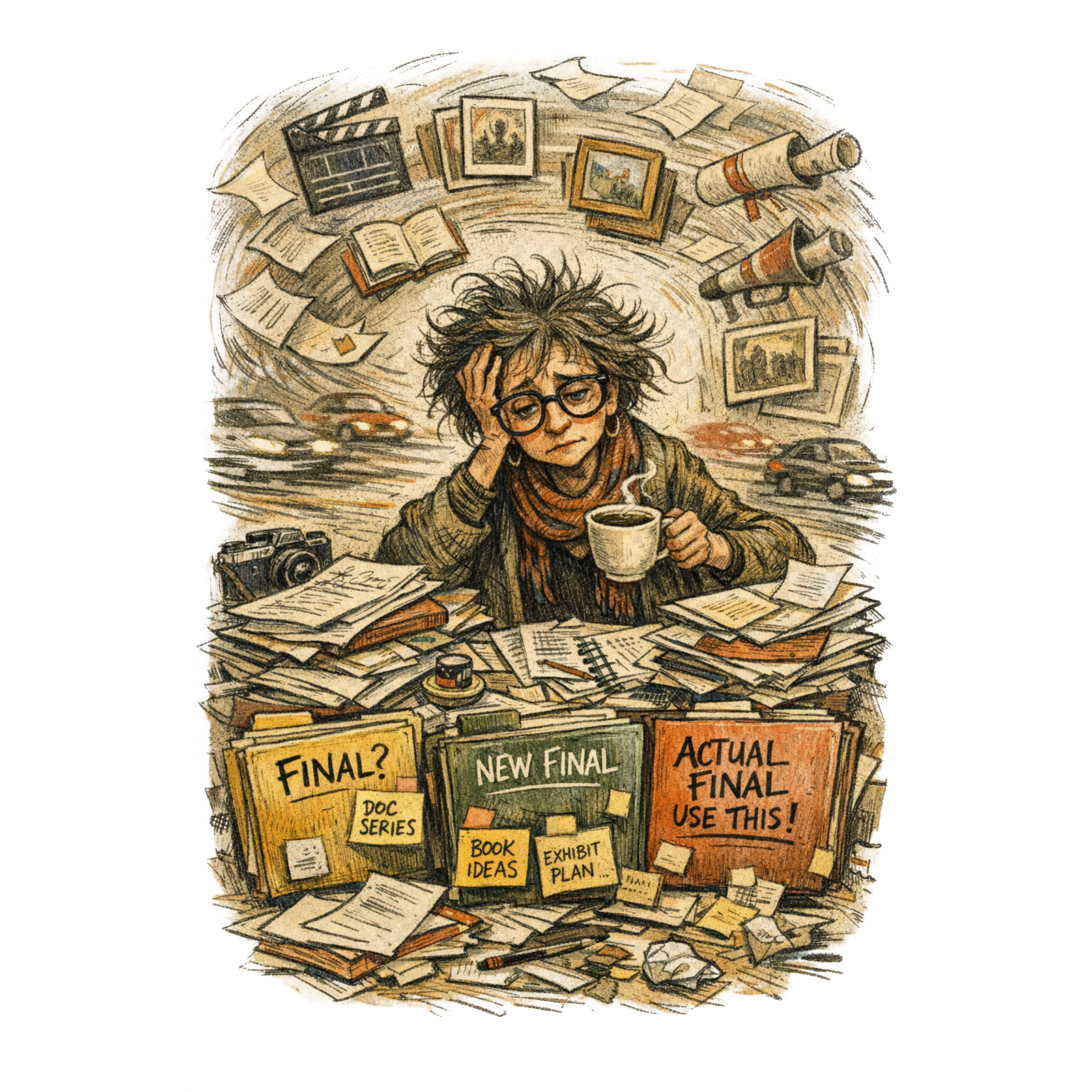
If ideas were currency, I’d be retired.
Not financially. Just mentally.
My brain does not struggle to generate projects.
It struggles to leave them alone.
Documentary series.
Book concepts.
Exhibition themes.
Collaborations.
Community campaigns.
Spin-offs of spin-offs.
I once counted the number of active project folders on my desktop.
I stopped at twelve.
Three of them were labelled “Final.”
Two were labelled “New Final.”
One was called “ACTUAL FINAL USE THIS.”
None of them were finished.
Creative overwhelm doesn’t look dramatic from the outside.
From the outside, it looks like ambition.
Drive.
Vision.
Energy.
Inside, it feels like standing in the middle of a motorway trying to choose a lane while traffic speeds past in every direction.
The challenge isn’t lack of ideas.
It’s lack of courage to commit to just one.
When you’ve rebuilt your life, when you’ve experienced instability and then found momentum, there’s a temptation to maximise everything.
If one project works, why not three?
If three work, why not ten?
Opportunity feels fragile.
So you try to catch all of it.
Big vision sounds impressive.
“Long-term impact.”
“Multi-layered storytelling.”
“Cross-sector collaboration.”
And yes, vision matters.
But vision without focus becomes noise.
I have sat at my desk genuinely paralysed by possibility.
Should I push the documentary project forward?
Finish the manuscript?
Plan the next exhibition?
Start that new idea that’s been nudging me for a week?
All of them feel important.
All of them feel meaningful.
So instead of choosing, I open them all.
I’ll tweak a paragraph in one document.
Adjust a layout in another.
Sketch an outline for a third.
At the end of two hours, I’ve moved everything forward by approximately three millimetres.
Progress that feels busy but isn’t decisive.
Creative overwhelm disguises itself as productivity.
You’re not doing nothing.
You’re just not finishing anything.
There’s a particular frustration that builds when your mind runs faster than your calendar.
You see the bigger picture.
You see how it could connect.
You see the potential ripple effect.
But the execution requires narrowing.
And narrowing feels like loss.
Choosing one project means not choosing five others — at least not right now.
That’s uncomfortable when your identity is tied to purpose.
I care about the work.
That’s the complication.
These aren’t vanity projects.
They’re about people.
Stories.
Impact.
Change.
When ideas are rooted in meaning, it becomes harder to prioritise.
Everything feels urgent.
Everything feels necessary.
And that’s where overwhelm takes hold.
I once opened my project management system and realised I had so many tabs open that I couldn’t see the actual content anymore.
It was almost poetic.
So much intention that it obscured clarity.
The emotional core of this isn’t laziness.
It’s fear.
Fear that if you choose wrong, you waste time.
Fear that if you focus too narrowly, you miss opportunity.
Fear that if you slow down, momentum disappears.
After rebuilding from instability, momentum feels sacred.
You don’t want to squander it.
So you stretch yourself thin to preserve it.
The irony is that thin focus weakens momentum more than stillness ever could.
I remember a week where I genuinely felt exhausted, not from volume of work, but from the mental load of unfinished plans.
Every idea was whispering.
Don’t forget me.
Start me.
Finish me.
Expand me.
My brain felt like a whiteboard covered in scribbles with no clear next step.
And here’s the uncomfortable realisation I had to sit with:
Having many ideas is not the same as having courage.
Courage is choosing one.
Courage is closing the other eleven folders.
Courage is saying, “This one. Now.”
There’s something deeply exposing about committing publicly to a single project.
Once you commit, you’re accountable.
You can’t hide behind the safety of “still developing.”
You have to execute.
And execution is where judgement enters.
Ideas are exciting.
Execution is vulnerable.
I’ve caught myself staying in idea mode longer than necessary because ideas are safe.
They’re hypothetical.
They haven’t been tested.
They haven’t been criticised.
They haven’t failed.
A finished project can be evaluated.
An unfinished one remains potential.
Potential is intoxicating.
But it doesn’t build anything.
There was a point where I had to have a slightly stern conversation with myself.
Not motivational.
Practical.
You don’t need more ideas.
You need fewer active ones.
Focus beats frenzy.
That line sounds simple.
It is not simple in practice.
Because focus requires sacrifice.
It requires ignoring the part of your brain that thrives on novelty.
It requires discipline when inspiration is easier.
I started implementing a rule.
No new major project until one is finished.
At first, it felt restrictive.
Like telling a child they can’t open another toy until they tidy the first.
But something interesting happened.
When I narrowed my focus, progress accelerated.
Instead of spreading effort thinly across twelve folders, I poured it into one.
And that one moved.
Substantially.
Momentum returned — not because I was doing more, but because I was doing less with intention.
Creative overwhelm often hides an identity issue too.
When you’ve built your life around purpose, productivity can become proof.
The more projects in motion, the more legitimate you feel.
The fuller the board, the more impactful you appear.
But impact isn’t measured in simultaneous activity.
It’s measured in completed work.
Completed work travels.
Completed work influences.
Completed work builds trust.
Half-finished concepts don’t.
The comedy of my “Final” folders now makes me smile.
I can almost see the timeline of indecision in the file names.
Final_v2
Final_UseThis
Final_REAL
Final_REAL2
Each version slightly different.
Each version not quite committed.
Behind each was a version of me hesitating.
Wanting it to be perfect before moving forward.
Wanting to ensure it would land before releasing it.
But that’s not how creativity works.
You don’t control reception.
You control completion.
The frustration I felt during those overloaded seasons wasn’t about lack of time.
It was about lack of prioritisation.
Once I accepted that I cannot execute everything simultaneously, something calmed.
The ideas didn’t disappear.
They simply waited.
And waiting isn’t abandonment.
It’s sequencing.
There’s maturity in sequencing.
In understanding that a decade-long career is not built in a single year.
That not every good idea is a now idea.
That narrowing is not shrinking.
It’s strengthening.
When I look at the projects that have truly shaped my work, they were never born out of frenzy.
They were born out of focused commitment.
Sustained attention.
Repeated effort.
They didn’t compete with eleven other initiatives.
They were chosen.
And being chosen matters.
To the work.
To the people involved.
To you.
Creative overwhelm makes you feel active.
Focus makes you effective.
The difference is subtle but powerful.
I still have more ideas than I can realistically execute.
That hasn’t changed.
What has changed is my response.
I write them down.
I park them.
I return to the one in front of me.
Because courage in creativity isn’t dreaming big.
It’s finishing small, consistently.
And then finishing the next.
Focus beats frenzy.
Every time.
Not because ideas are bad.
But because unfinished brilliance serves no one.
Including you.