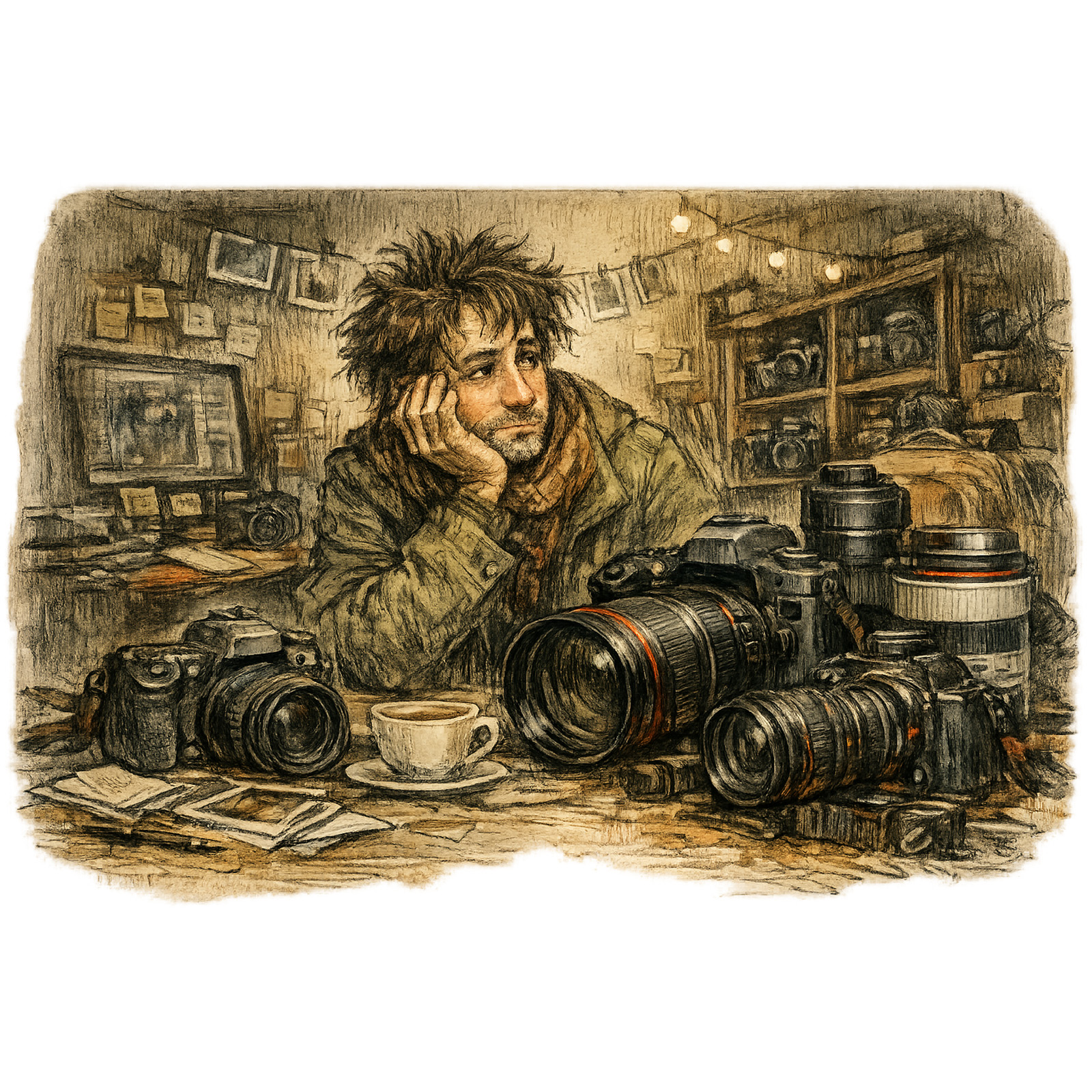
If you spend more than ten minutes around photographers, someone will eventually say the words:
“I’m thinking of upgrading.”
Not in a dramatic way. In a slightly hushed, reverent tone. Like they’re considering a pilgrimage.
I’ve said it myself.
Usually at the exact moment my confidence dips.
That timing is not accidental.
When I was given a camera in 2015, it wasn’t the latest model. It wasn’t glamorous. It didn’t arrive with a cinematic backstory.
It was just… a camera.
And at that stage of my life, that was more than enough.
I wasn’t thinking about dynamic range or pixel density. I was thinking about focus. About having something constructive to pour attention into. About rebuilding discipline.
The camera was a tool.
Nothing more.
But as the work grew — as weddings came in, as projects expanded, as exhibitions became real — something subtle crept in.
Comparison, yes. We’ve covered that.
But alongside comparison came gear anxiety.
You start noticing what everyone else is using.
You hear model numbers in conversations like secret codes.
You see behind-the-scenes reels where someone casually swings a lens that costs more than your first car.
And the thought creeps in:
Maybe I need better equipment.
Not because the current camera isn’t working.
But because better equipment feels like legitimacy.
There’s a quiet belief buried in the creative world that real professionals use certain gear.
And if you’re not using it, maybe you’re not quite there yet.
That belief is powerful.
Especially when you didn’t come through the traditional route.
Especially when you still occasionally feel like you’ve snuck into a room you’re not entirely qualified for.
Upgrading feels like proof.
Proof that you belong.
Proof that you’ve progressed.
Proof that you’re serious.
I remember the first time I held a higher-end body in my hands. The weight alone made me feel more capable.
Isn’t that ridiculous?
The same brain.
The same eye.
The same experience.
But heavier metal, and suddenly I felt more legitimate.
There’s a particular excitement that comes with new gear.
The unboxing ritual.
The smooth click of a fresh shutter.
The slightly ridiculous smell of new equipment that you pretend not to notice but absolutely do.
You tell yourself this is about quality.
Sometimes it is.
But often it’s about identity.
The thought process goes something like this:
Once I have this lens, my work will improve.
Once I have this body, I’ll feel confident.
Once I have this setup, I’ll finally be on the same level.
The problem is, that “once” keeps moving.
There’s always something newer.
Sharper.
Faster.
More impressive.
And if you’re not careful, you start confusing upgrades with growth.
I’ve convinced myself before that a new lens would solve a creative slump.
That it would unlock something I was missing.
And here’s the honest truth.
It didn’t.
It made the images a little sharper.
It made low-light situations slightly easier.
It did not eliminate doubt.
If anything, it sharpened it.
Because when you invest heavily in equipment and still feel uncertain, the excuse disappears.
You can’t say, “It’s just my gear.”
Now it’s you.
There’s something uncomfortable about that.
It’s easier to believe the limitation is technical rather than internal.
Gear myth is comforting.
It tells you the solution is transactional.
Spend money.
Gain confidence.
Unfortunately, confidence doesn’t work that way.
The emotional high of new equipment is real.
You shoot differently for a few days.
You feel energised.
You post a few images and think, “Yes. This is it.”
Then, gradually, the novelty fades.
The new lens becomes the lens.
The new body becomes the body.
And you’re back to facing the same internal questions.
Am I good enough?
Am I progressing?
Do I really belong here?
No piece of hardware answers those.
I had to sit with a slightly uncomfortable realisation at one point.
Some of the images I was most proud of were taken with the early gear I started with.
The camera I was given.
The one that didn’t scream professional.
The one that didn’t cost a fortune.
The images that drew emotional reactions.
The images that sparked conversations.
The images that ended up framed on walls.
They weren’t limited by the equipment.
They were shaped by attention.
By patience.
By empathy.
By timing.
Vision outlasts hardware.
That’s not a romantic line. It’s observable reality.
There are photographers with modest setups producing extraordinary work.
And there are photographers with top-tier equipment producing technically perfect, emotionally empty images.
Gear enhances capacity.
It does not replace vision.
And yet, when insecurity creeps in, gear is the easiest thing to target.
It’s tangible.
Measurable.
Upgradable.
Internal growth is slower.
Less glamorous.
You can’t unbox discipline.
You can’t mount consistency onto a tripod.
You can’t update courage with firmware.
Those things are built through repetition.
Through showing up.
Through making images when you don’t feel particularly inspired.
I still enjoy good equipment.
I’m not anti-gear. Let’s not swing to the other extreme.
Better tools can absolutely improve workflow, reliability, and quality in certain contexts.
But they are multipliers.
Not foundations.
If your confidence is at zero, multiplying it by ten still gives you zero.
That’s the uncomfortable maths.
There was a period where I nearly convinced myself that my next step professionally required a significant upgrade.
Not because my clients were complaining.
Not because my images were failing.
Because other photographers were posting about theirs.
It’s fascinating how easily marketing seeps into your sense of self.
You see phrases like:
“Game changer.”
“Next level.”
“Never looking back.”
And you wonder if you’re missing something critical.
But the real game changer for me wasn’t a lens.
It was consistency.
It was finishing projects.
It was refining how I told stories.
It was building relationships.
None of those required a firmware update.
When I look back at the early years, I’m almost grateful I didn’t start with the best equipment available.
It forced me to focus on fundamentals.
Light.
Composition.
Timing.
Connection.
When you don’t have the safety net of ultra-fast autofocus or extreme low-light performance, you learn to read rooms.
You learn to anticipate moments.
You learn to position yourself intentionally.
Those skills compound.
Hardware ages.
Vision deepens.
There’s a subtle confidence that comes from realising your work stands on more than technology.
That if tomorrow the latest model disappeared, you could still produce something meaningful.
Because the camera is an extension.
Not the origin.
When I catch myself browsing gear reviews late at night now, I pause.
Not to shame myself.
Just to ask a question.
Am I upgrading capability?
Or am I trying to upgrade confidence?
If it’s the first, that’s a strategic decision.
If it’s the second, I know the purchase won’t solve it.
Confidence built on equipment will wobble with every new release cycle.
Confidence built on repetition endures.
The myth that equipment equals legitimacy is seductive.
It offers a shortcut.
It says, “Once you look the part, you’ll feel the part.”
But in my experience, you feel the part by doing the work long enough that the part fits naturally.
The camera I was given after rehab wasn’t prestigious.
It wasn’t symbolic of success.
It was symbolic of possibility.
And possibility is more powerful than prestige.
That early season taught me something I might not have learned otherwise.
You don’t need the best tools to begin.
You need willingness.
And willingness, over time, becomes experience.
Experience becomes confidence.
Confidence becomes identity.
Hardware will always evolve.
There will always be something newer.
Faster.
More advanced.
But vision?
Vision compounds.
It refines.
It matures.
And it travels with you, regardless of what’s hanging around your neck.
The gear myth fades when you realise this simple truth:
Your eye is the asset.
The camera is the accessory.
And accessories don’t define you.
They assist you.
That’s a very different thing.