There’s a particular kind of awkward silence that happens when someone asks,
“So what do you do?”
It’s not dramatic. It’s not cinematic. It’s just… a pause.
A pause where your brain flicks through possible versions of yourself like it’s scrolling a menu.
That was me for years.
“What do you do?”
And I’d say, “Oh… I just take photos.”
Just.
As if it were a hobby.
As if it were something I accidentally tripped into.
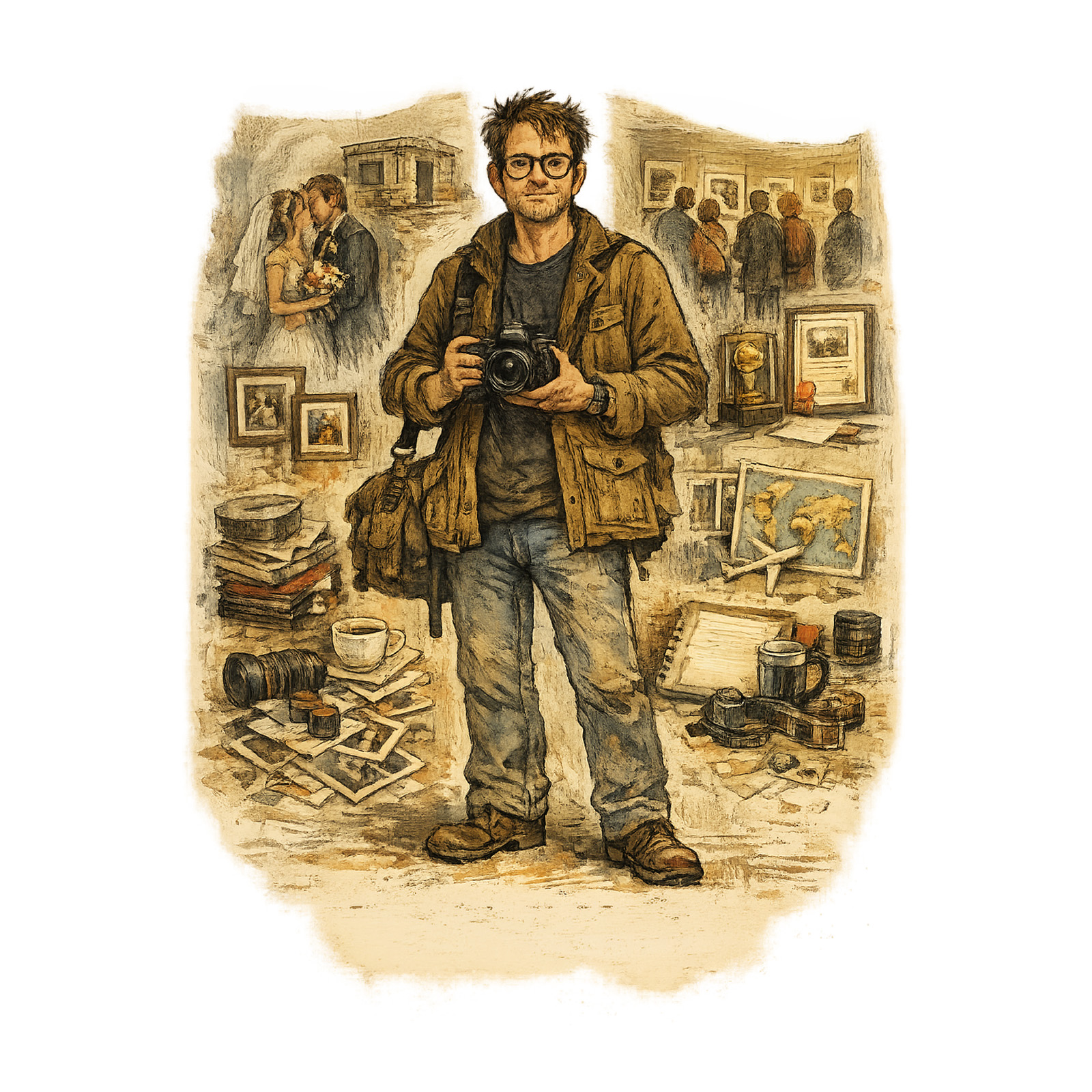
As if there weren’t exhibitions, books, weddings, community projects, late nights, early mornings, and 500+ ceremonies behind that word.
Just take photos.
It sounds humble. It sounds safe. It sounds like someone who hasn’t quite given themselves permission to stand fully in the room.
The truth is, I didn’t feel like I was allowed to say the word “photographer.”
Not properly.
Because in my head, photographers were people who went to art school. People who had portfolios at 19. People who spoke about light like it was a spiritual calling. People who knew what aperture was before their twenties.
I didn’t.
In 2015, I was given a camera after coming out of rehab.
That’s not the typical origin story you hear at networking events.
There was no grand creative awakening. No childhood darkroom. No parent who worked in the arts. There was uncertainty. There was recovery. There was the quiet, slightly shaky feeling of starting again when you’re not entirely sure who you are anymore.
The camera wasn’t a career plan.
It was something to focus on.
Something steady.
Something that didn’t ask awkward questions about your past.
I didn’t sit there thinking, “I shall now become a professional photographer.”
I thought, “This is something I can learn.”
That felt safer.
Learning is neutral. Identity is risky.
Learning doesn’t require you to believe in yourself. Identity does.
The first time someone paid me to photograph their wedding, I was convinced they’d made a mistake.
Not a small mistake. A full administrative error.
Surely they meant to hire someone else. Surely at some point they’d realise I was just… winging it.
I wasn’t winging it. I was working hard. I was learning constantly. I was studying light, composition, timing. I was practising relentlessly.
But imposter syndrome doesn’t respond to logic.
It responds to history.
And my history was louder than my progress.
For two years before all of that, life looked very different. It involved sofa surfing. Temporary places. Instability. Long days that didn’t have structure. You don’t come out of that and immediately feel like a “creative professional.” You come out of that feeling grateful to have somewhere to be.
So when someone said, “You’re really good at this,” my instinct wasn’t pride.
It was suspicion.
Good? Are you sure?
I remember winning my first award. I won’t pretend I played it cool. I was buzzing. Properly buzzing. I told my family. I told friends. I may have refreshed the results page more times than necessary.
And then someone asked me what I did.
“I just take photos.”
It’s almost impressive how quickly the brain can downgrade itself.
You can stand in a room with your work on the wall. You can see people studying it. You can watch strangers pause in front of something you created.
And then someone asks what you do and you shrink it down to “just.”
The word “just” is a small word. But it carries weight.
It protects you.
Because if you’re “just taking photos,” then nobody expects too much. Nobody expects expertise. Nobody expects depth. Nobody expects you to fully own it.
Owning it feels dangerous.
Owning it means you could fail publicly.
Owning it means you’re exposed.
There’s something deeply uncomfortable about saying, “I’m a photographer,” when part of your mind still remembers a different version of you.
The version who didn’t have direction.
The version who wasn’t stable.
The version who didn’t feel like they belonged in many rooms.
It’s strange how the past lingers. Not in a dramatic, cinematic way. Just quietly. Like background noise.
Even as the work grew — weddings, projects, collaborations, exhibitions — there was always a slight internal question:
Who do you think you are?
Not aggressively. Just gently. Persistently.
Who do you think you are to do this?
And the irony is, the more visible the work became, the louder that question sometimes felt.
When exhibitions started happening in bigger spaces, when people began using phrases like “impact” and “important work,” I’d nod politely and then go home thinking, “Don’t get ahead of yourself.”
There’s a peculiar tension between gratitude and ownership.
Gratitude says, “I’m lucky to be here.”
Ownership says, “I built this.”
For a long time, I was comfortable with the first one and allergic to the second.
I could say, “I’m grateful.”
I struggled to say, “I worked for this.”
Because working for something means admitting it’s yours.
And if it’s yours, you can lose it.
Imposter syndrome isn’t loud for most people. It doesn’t shout. It whispers.
It says things like:
You got lucky.
You’re not trained.
You don’t have the right background.
Real photographers would know more.
Sooner or later, someone will notice.
And here’s the strange part.
The more I worked, the more those thoughts didn’t disappear — they just got quieter.
They didn’t vanish when I had photographed 50 weddings.
They didn’t vanish at 200.
They didn’t vanish when projects started drawing serious attention.
They softened.
Because something else grew louder.
Evidence.
Not evidence in a flashy way. Just steady evidence.
Clients came back.
Organisations trusted me.
People shared their stories.
Work got finished.
That’s the part nobody tells you.
Confidence doesn’t arrive as a feeling first.
It arrives as repetition.
I didn’t wake up one morning suddenly feeling like a photographer.
I shot.
And shot again.
And edited.
And delivered.
And showed up.
Over and over.
The identity followed the behaviour.
Not the other way round.
There’s a moment I remember clearly.
Someone introduced me at an event. They didn’t hesitate. They didn’t soften it.
“This is Christopher. He’s a photographer.”
And I didn’t correct them.
I didn’t add “just.”
I didn’t laugh it off.
I didn’t downgrade it.
I just nodded.
It sounds minor. It wasn’t.
Because in that moment, I realised something.
Nobody else was questioning whether I was allowed to use that word.
Only me.
And here’s the uncomfortable truth: if you keep refusing to claim your identity, you make it harder for other people to trust it.
When you say “just,” people hear uncertainty.
When you shrink your work, people subconsciously shrink their perception of it too.
I had spent years trying to avoid arrogance.
What I’d actually been avoiding was ownership.
There’s a difference.
Arrogance says, “I’m better than everyone.”
Ownership says, “This is what I do.”
One is loud.
The other is steady.
The day I finally said, clearly and without apology, “I’m a photographer,” nothing dramatic happened.
No confetti.
No internal fireworks.
No sudden transformation.
But something subtle shifted.
I stopped asking permission.
That’s what imposter syndrome really is — permission waiting.
Waiting for a certificate.
Waiting for a bigger milestone.
Waiting for someone official to confirm you’re allowed.
I never went to art school.
I didn’t start at nineteen.
I didn’t follow the traditional route.
But I showed up.
Again and again.
And at some point, showing up becomes proof.
I still feel the whisper sometimes.
Before a big project.
Before a new direction.
Before something slightly outside my comfort zone.
Who do you think you are?
And now the answer is simple.
I’m someone who kept going.
That’s it.
Not the most naturally gifted.
Not the most academically trained.
Not the most connected.
Just the one who stayed.
The gap between who you were and who you’re becoming never fully disappears. It just narrows.
You carry both.
The person who was uncertain.
The person who is steady.
The person who didn’t feel legitimate.
The person who has earned their place.
And here’s the shift that took me years to understand:
Identity isn’t something you qualify for.
It’s something you behave into.
You don’t feel like a photographer and then start working.
You work like a photographer, repeatedly, until the word fits.
The credentials help some people.
The degrees help some people.
But action helps everyone.
If you’re waiting to feel ready, you’ll wait a long time.
If you’re waiting for someone to officially crown you, you’ll wait even longer.
The day I said “I’m a photographer” wasn’t the day I became one.
It was the day I stopped arguing with the evidence.
And that, quietly, changed everything.