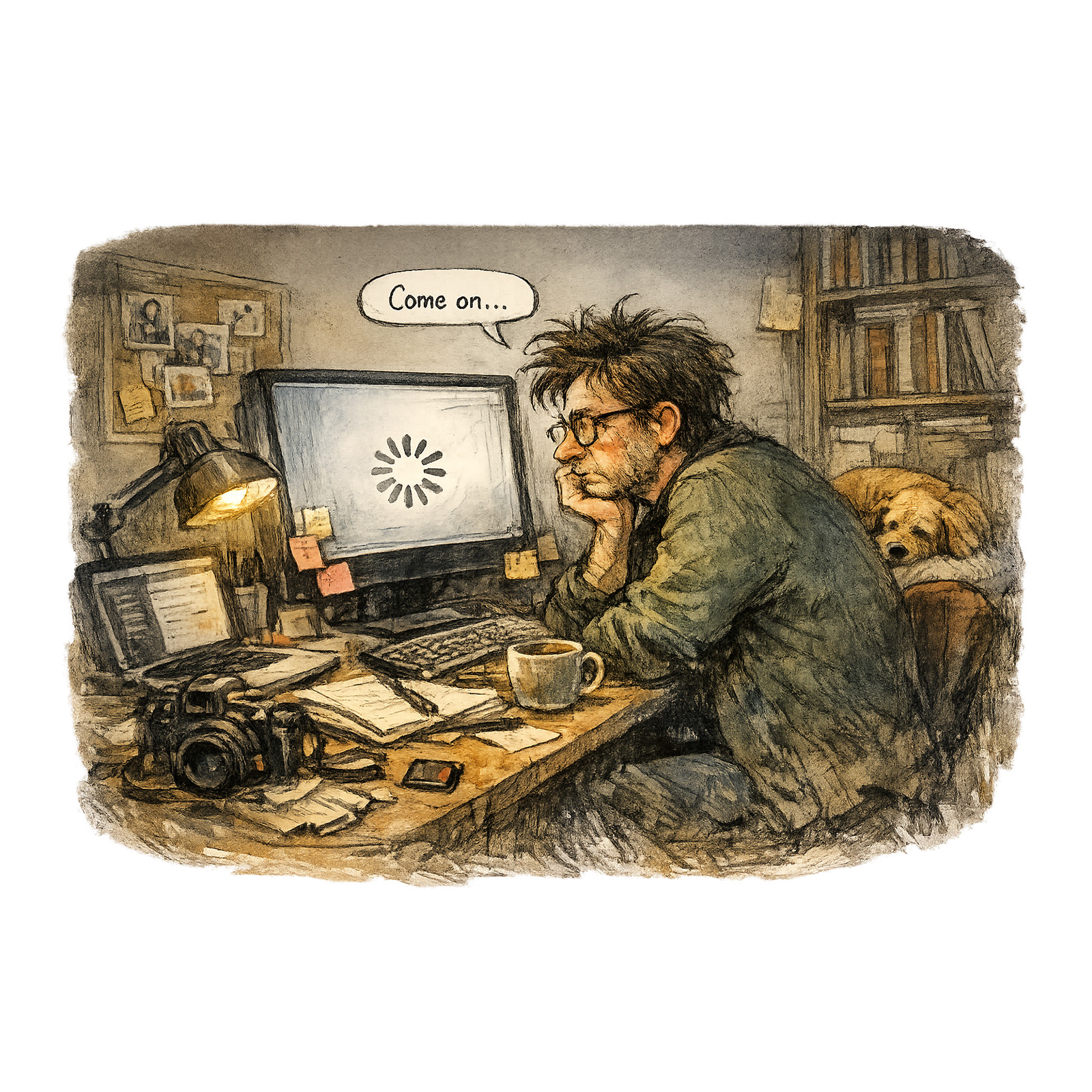
There are days when the only colleague I speak to is Lightroom.
And Lightroom, if we’re being honest, is not particularly conversational.
It freezes occasionally.
It ignores me at inconvenient moments.
And when I ask it to cooperate, it offers a spinning wheel instead.
“Come on,” I’ll say to the screen.
As if persuasion might help.
When you run a solo creative business, silence becomes normal.
There’s no office chatter.
No shared coffee breaks.
No one glancing over and saying, “How’s that project going?”
There’s just you.
Your screen.
Your inbox.
Your deadlines.
Isolation isn’t dramatic.
It’s quiet.
And quiet accumulates.
Being a solo business owner means carrying responsibility without shared weight.
Every decision lands on your desk.
Pricing.
Creative direction.
Client communication.
Technical troubleshooting.
Marketing.
Accounting.
There’s no internal meeting to distribute tasks.
There’s just you, switching hats repeatedly.
In the early years, the solitude felt focused.
Efficient.
Productive.
I could structure my day exactly as needed.
No interruptions.
No distractions.
But over time, something else surfaced.
A subtle loneliness.
Not sadness.
Absence.
There’s a difference between working alone and feeling alone.
Working alone is logistical.
Feeling alone is emotional.
When you’re navigating complex projects — exhibitions, collaborative campaigns, sensitive interviews — you hold weight internally.
And without colleagues to offload casually to, that weight stays with you.
I’ve had days where I finished editing a powerful interview and instinctively looked up, almost expecting to share a reaction.
And then remembered.
There’s no one in the room.
It’s a strange adjustment.
In more traditional workplaces, shared experience diffuses pressure.
You debrief naturally.
You process out loud.
As a solo creative, you internalise.
And internalisation can become isolation if you’re not careful.
The comedy of it is subtle but real.
I’ve found myself narrating tasks aloud.
“Right, we’ll just export these now.”
We.
As if there’s a small team involved.
There isn’t.
It’s me.
And occasionally the dog, who is supportive but not particularly helpful with colour grading.
Talking to software like it’s a colleague is not a long-term strategy.
But it reveals something.
The human need for shared presence.
Isolation isn’t always obvious during busy seasons.
When weddings stack up or projects intensify, there’s interaction.
Clients.
Interview subjects.
Collaborators.
But those interactions are contextual.
They’re tied to work.
They’re not the same as shared creative processing.
The emotional core here is quiet loneliness.
Not dramatic.
Not headline-worthy.
Just the absence of someone who understands the specifics of your daily grind.
There are moments where decision fatigue sets in.
And you wish someone else could simply say, “Yes, that’s the right direction.”
Not to take responsibility away.
Just to share it.
Being solely accountable for outcomes is empowering.
It’s also heavy.
If a project succeeds, it’s yours.
If it falters, it’s yours.
There’s no buffer.
That can intensify self-critique.
No one is there to counterbalance it in real time.
In earlier life chapters, instability was communal in its own way.
There were people around.
Conversations happening.
Even if circumstances were uncertain, there was shared experience.
Running a solo business flips that dynamic.
Stability increases.
Community can decrease if you’re not intentional.
I’ve noticed that some of my most productive days are also the quietest.
Hours pass without speaking.
Deep focus.
Efficient output.
And then the day ends and I realise I haven’t had a meaningful conversation.
That realisation can land strangely.
You’ve been active.
But not relational.
Creative work is often relational at its core.
It’s about people.
Stories.
Connection.
Yet the execution can be solitary.
Editing alone.
Writing alone.
Planning alone.
There’s also a misconception that independence equals strength.
And yes, independence is valuable.
But interdependence is healthier.
I’ve learned that waiting for community to appear is passive.
You must build it deliberately.
In the early stages, I didn’t prioritise that.
I focused on craft.
On growth.
On delivery.
Community felt secondary.
But isolation compounds quietly.
So I began reaching out intentionally.
Conversations with other creatives.
Not networking in the transactional sense.
Genuine dialogue.
What are you working on?
What’s challenging?
How are you structuring this season?
Those conversations shift weight.
You realise your doubts are not unique.
Your hesitations are not singular.
Your struggles are not personal failures.
They’re common creative patterns.
Isolation amplifies insecurity.
Community normalises it.
There’s also something grounding about hearing others articulate their own uncertainty.
It dissolves the myth that everyone else is operating seamlessly.
We are all adjusting.
All refining.
All occasionally staring at software and hoping it behaves.
I’ve also learned to separate solitude from isolation.
Solitude can be productive.
Restorative.
Creative.
Isolation is prolonged solitude without connection.
One fuels craft.
The other erodes energy.
The difference lies in intention.
If I schedule collaborative meetings.
If I attend exhibitions not as organiser but as participant.
If I maintain dialogue with peers.
Solitude becomes chosen, not imposed.
The purpose shift here is clear.
Build community deliberately.
Don’t assume it will happen organically.
Creative work attracts independent personalities.
That independence must be balanced with relational investment.
There’s courage in admitting loneliness.
Especially when your public persona might look established.
Visibility.
All external signals of connection.
Internally, you can still feel alone in decision-making.
Alone in doubt.
Alone in pressure.
Naming that removes some of its power.
I no longer romanticise the lone creative.
The solitary genius in a room.
That image is incomplete.
Sustainable creativity requires connection.
Shared thought.
Mutual reflection.
Lightroom can stay silent.
I don’t need it to affirm me.
But I do need peers.
Conversations.
Because responsibility shared, even conversationally, feels lighter.
The lonely creative doesn’t need to remain lonely.
But it requires effort.
Initiation.
Openness.
And that effort pays off.
Not in dramatic transformation.
In steady grounding.
In reminders that you’re not the only one navigating complexity.
In the relief of someone saying, “Yes, I’ve felt that too.”
That sentence alone reduces isolation.
Solo business owner does not mean solitary human.
And remembering that changes everything.
From quiet rooms to connected networks.
From isolation to intentional community.
Because creativity thrives not just in silence.
But in shared understanding.
How to find this article: