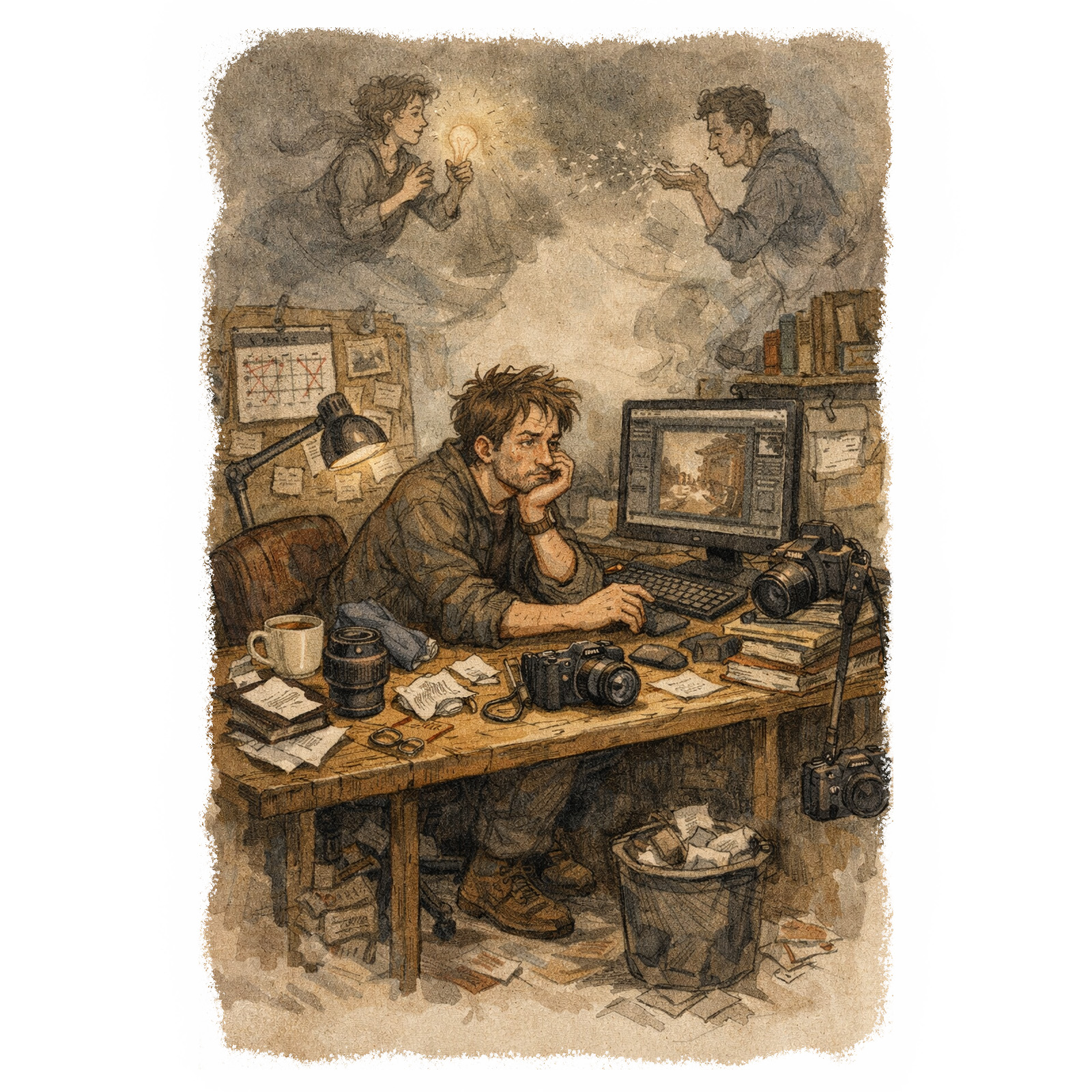
There’s a version of creativity people like to believe in.
It’s cinematic.
You wake up inspired.
Light falls perfectly through the window.
Ideas arrive fully formed.
You step into flow and everything works.
It’s beautiful.
It’s also mostly fiction.
When I started photography seriously after 2015, I didn’t have a romantic creative routine.
I had structure.
Structure was new to me. Valuable. Necessary.
I didn’t sit around waiting for inspiration. I practised. Repeatedly. Sometimes clumsily.
Because when you’re rebuilding your life, you don’t wait for a muse.
You build habits.
Creativity isn’t magic.
It’s repetition.
But repetition doesn’t look exciting on social media.
There are no cinematic montages of me sitting at a desk editing frame after frame.
There are no dramatic soundtracks while I practise exposure in dull afternoon light.
There’s just showing up.
And if I’m honest, showing up is often preceded by resistance.
There’s a particular resistance that appears just before starting.
It’s subtle.
You tell yourself you’ll begin in ten minutes.
First, you’ll tidy the desk.
Then you’ll make tea.
Then you’ll clean your lenses.
I have cleaned perfectly clean lenses to avoid starting.
That’s not maintenance.
That’s procrastination wearing responsibility.
You convince yourself you’re preparing.
In reality, you’re delaying.
The romantic myth of creativity tells you that when you feel ready, the work will flow.
The truth is usually the opposite.
You start before you feel ready.
And somewhere in the middle, momentum arrives.
After 2015, I didn’t have the luxury of waiting for perfect creative conditions.
I was learning from scratch.
Understanding exposure.
Studying light.
Practising composition.
Over and over.
There was nothing glamorous about those early sessions.
I’d take photographs that were average.
Then slightly better.
Then occasionally strong.
And then back to average again.
That’s how craft develops.
Not in bursts of brilliance.
In steady repetition.
There’s something comforting about believing creativity is magic.
If it’s magic, then inconsistency isn’t your fault.
You just didn’t “have it” that day.
But if creativity is craft, then inconsistency is part of training.
You don’t wake up fluent.
You practise fluency.
The emotional core of this chapter is resistance before starting.
That small internal pushback that says:
Maybe tomorrow.
Maybe when you feel clearer.
Maybe when conditions are better.
I’ve learned to recognise that voice.
It isn’t laziness.
It’s discomfort.
Starting requires energy.
It requires the willingness to be imperfect for a while.
It requires facing the possibility that today’s work might not be strong.
And that’s uncomfortable.
Especially when your identity is tied to output.
There are days when I sit down to edit and think, “I’m not in the mood.”
That sentence used to carry weight.
Now it carries less.
Mood is unreliable.
Discipline is stable.
There’s a shift that happens when you stop asking whether you feel inspired and start asking whether you’re scheduled.
Am I supposed to be working now?
Yes.
Then begin.
Not dramatically.
Just open the file.
Make the first adjustment.
Write the first sentence.
Creativity rarely arrives before motion.
It arrives during.
Some of my most productive editing sessions began reluctantly.
I’d sit down half-committed.
Adjust a frame.
Then another.
And gradually something would shift.
Focus would deepen.
Clarity would sharpen.
But that clarity didn’t appear while I was making tea.
It appeared while I was working.
The myth of waiting for inspiration is seductive because it removes responsibility.
If inspiration doesn’t arrive, you’re excused.
But when you understand that craft builds through repetition, the responsibility changes.
You show up whether it feels magical or not.
After 2015, repetition was grounding.
It wasn’t glamorous, but it was steady.
Practising composition taught me patience.
Editing consistently taught me judgement.
Reviewing mistakes taught me humility.
None of that felt like magic.
It felt like work.
There’s humour in how creative resistance manifests.
I’ve reorganised folders to avoid writing.
Adjusted camera straps to avoid shooting.
Re-labelled projects instead of progressing them.
Busy without movement.
That’s the difference.
Activity isn’t output.
Preparation isn’t production.
At some point, you must begin.
There’s also a fear hidden inside resistance.
What if it’s not good today?
What if the words feel flat?
What if the images don’t land?
Waiting for inspiration is often waiting for safety.
If I feel inspired, I’ll perform well.
If I don’t feel inspired, I might fail.
But the uncomfortable truth is this:
Some of your best work will begin on uninspired days.
Because you showed up anyway.
Creativity isn’t magic.
It’s muscle.
And muscles strengthen through repetition, not mood.
When I look back at the growth in my work, I don’t see bursts of genius.
I see consistency.
Projects finished.
Skills refined.
Patterns learned.
None of that required lightning strikes.
It required attendance.
Show up.
Do the work.
Repeat.
The purpose shift here is simple but not easy:
Show up regardless of mood.
Not because you’re robotic.
Because you respect the craft.
If I only worked when I felt inspired, half my exhibitions wouldn’t exist.
Half the books wouldn’t be written.
Half the conversations wouldn’t have been held.
Waiting is comfortable.
Working is clarifying.
There’s also something deeply stabilising about disciplined creativity.
It builds trust with yourself.
You learn that you can begin even when you don’t feel brilliant.
You learn that effort compounds.
You learn that consistency outperforms intensity.
Intensity burns bright.
Consistency builds quietly.
Magic is unpredictable.
Craft is reliable.
I still enjoy days where inspiration flows easily.
Those days feel light.
But I no longer depend on them.
The real progress has come from the quieter days.
The slightly resistant mornings.
The sessions that began reluctantly and ended productively.
If creativity were magic, I wouldn’t trust it.
Because magic fades.
Craft remains.
And craft grows stronger the more you practise.
So yes, sometimes I still clean lenses before shooting.
Old habits.
But eventually, I pick up the camera.
Because inspiration rarely knocks politely.
It shows up when you’re already working.
And if you’re not working, it moves on.
Creativity isn’t magic.
It’s commitment.
And commitment, repeated enough times, starts to look a lot like talent.
How to find this article: