There is a very specific kind of whiplash that happens after a big event.
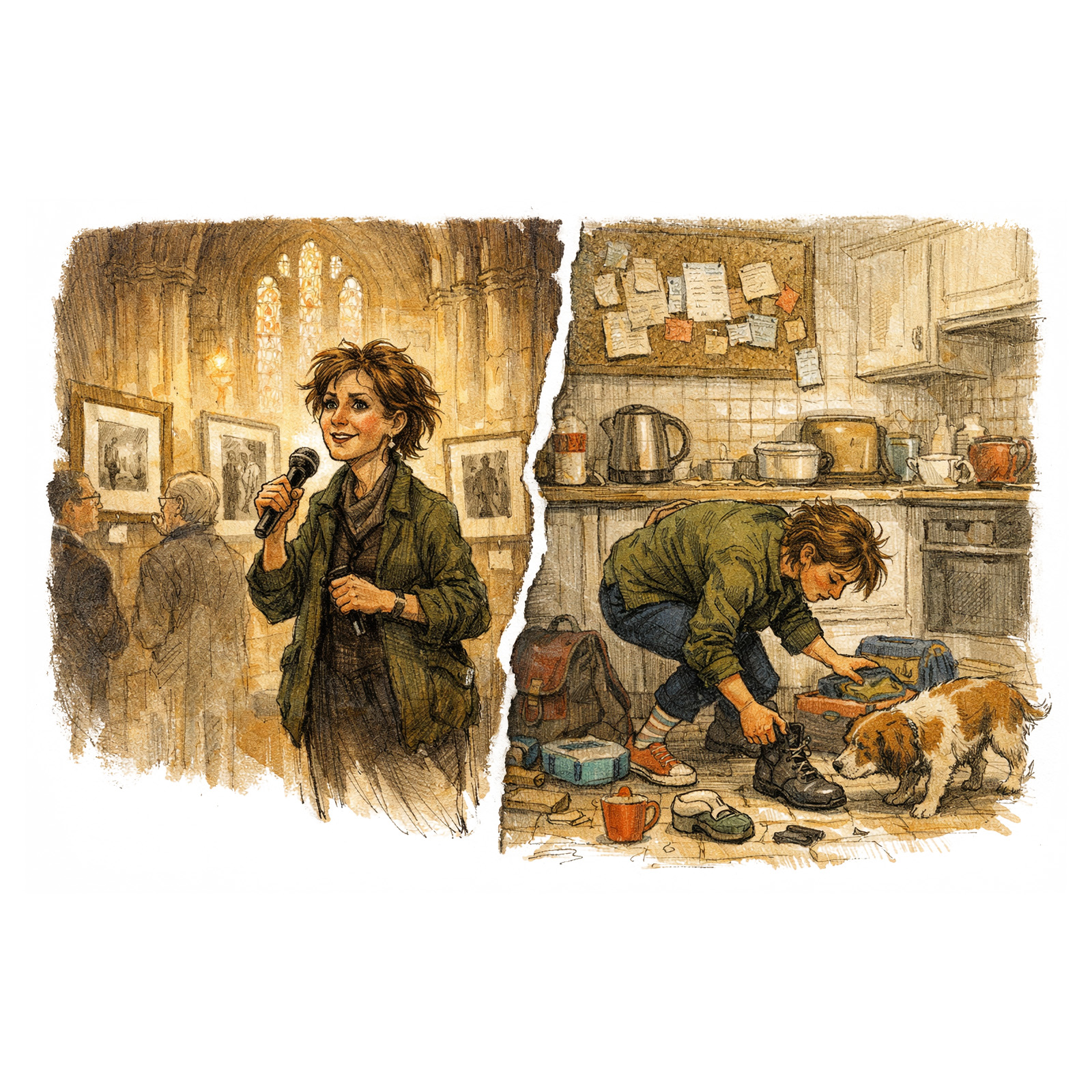
One evening you’re standing in a cathedral, lights warm against stone walls that have held centuries of history. Your photographs are framed properly — not blu-tacked, not clipped to a board — framed. People are walking slowly, reading captions, discussing stories you helped tell.
Someone hands you a microphone.
You speak.
You thank people.
You try to sound composed while your heart is beating louder than the echo in the nave.
It feels significant.
It feels like arrival.
Then, less than twelve hours later, you’re standing in your kitchen trying to locate a missing school shoe.
From gallery speech to school run in under half a day.
That’s the part no one puts on Instagram.
The post-success anti-climax.
Exhibitions in cathedrals are not small things.
They are large, resonant spaces. There’s something about hanging work in a building like that that amplifies everything. The scale. The silence. The weight of it.
You stand back and think, “This is real.”
Visitors come in waves. Some pause briefly. Others stay for long stretches. Conversations form in corners. Strangers ask thoughtful questions.
It feels important.
And when you’ve rebuilt your life from instability, moments like that feel especially charged.
Because you remember earlier seasons.
You remember quieter, colder rooms.
So standing in a cathedral, with your work drawing attention, doesn’t just feel professional.
It feels improbable.
And that improbability can be intoxicating.
Recognition in a large space does something to your nervous system. It elevates you slightly. Not in arrogance. In awareness.
People are seeing this.
They’re engaging with it.
It matters.
The challenge isn’t the exhibition itself.
The challenge is the morning after.
The email inbox doesn’t glow differently.
The kettle doesn’t boil more ceremoniously.
Your desk still has admin waiting.
Your dog still wants a walk.
Life resumes with ruthless normality.
There’s a strange anti-climax in that.
You half-expect some internal transformation. A permanent boost in confidence. A new level unlocked.
Instead, you’re packing lunch boxes.
And here’s the emotional core of it:
You feel slightly deflated.
Not because anything went wrong.
Because nothing dramatic continues.
The high fades.
The room empties.
The applause softens into memory.
And you’re left with ordinary Tuesday.
Post-success pressure is subtle.
It doesn’t say, “That wasn’t good enough.”
It says, “Now what?”
How do you top that?
How do you maintain that level?
How do you avoid slipping back into obscurity?
After one particular exhibition opening, I remember driving home feeling energised. Alive, even. Conversations replaying in my mind. Comments that landed deeply. Gratitude swirling around.
I got home. Sat down. Opened my laptop.
Silence.
No dramatic surge of new enquiries. No sudden wave of opportunity.
Just routine.
And I felt something I wasn’t expecting.
Emptiness.
Not depression. Not sadness.
Just a drop.
Like coming off stage and realising the stage lights don’t follow you into your living room.
We don’t talk much about that part.
We talk about the win. The milestone. The big room.
We don’t talk about the quiet after.
The anti-climax can be confusing.
You tell yourself you should be satisfied. Grateful. Energised.
Instead, you feel slightly flat.
I had to sit with that honestly.
Why does this feel heavier than I expected?
Part of it is chemistry.
Adrenaline fades.
Attention fades.
But part of it is identity.
When you’ve worked toward something visible, when you’ve invested emotionally and practically into a large public moment, it temporarily becomes the centre of your focus.
Then it ends.
And your brain, which has been pointed toward that event for weeks or months, suddenly loses its target.
You stand in a cathedral one evening.
The next morning, you’re back at your desk with emails about printer ink.
The contrast is absurd.
And slightly funny.
I once gave a small speech in a large exhibition space and then, the following morning, found myself arguing with a printer that refused to cooperate.
From “Thank you all for coming” to “Why are you offline?” in less than 24 hours.
That’s real life.
But it messes with your perception of progress.
Because big moments feel like breakthroughs.
You assume they permanently shift your trajectory.
Sometimes they do in subtle ways.
But more often, they are peaks within a steady line.
The danger is building your sense of growth around peaks.
Peaks are thrilling.
They are not sustainable.
If you measure success by how often you stand in front of a crowd, you will spend a lot of time feeling underwhelmed.
The anti-climax isn’t failure.
It’s reality resetting.
And reality is less glamorous than a launch night.
There was a particular exhibition in a cathedral that drew significant attention. Conversations spilled beyond the building. Visitors returned with friends. It felt substantial.
I remember thinking, “This is a turning point.”
And maybe it was.
But not in the cinematic way I’d imagined.
The turning point wasn’t in the applause.
It was in the discipline the next week.
Did I keep showing up?
Did I continue refining?
Did I build on the momentum quietly?
Consistency matters more than moments.
That sentence feels less exciting than “Breakthrough.”
But it’s truer.
Moments are visible.
Consistency is structural.
After a big public event, there’s a temptation to chase another one quickly.
To replicate the high.
To secure the next large space.
To avoid returning to the slower, less visible work.
I’ve felt that pull.
Let’s line up the next one fast.
Keep the energy high.
Stay visible.
But rushing the next moment often dilutes the work.
Exhibitions that land well usually do so because they were prepared carefully.
Conversations were had. Stories were honoured. Logistics were considered.
They weren’t thrown together in response to a high.
They were built steadily.
The emotional lesson for me was this:
If your confidence spikes only during public recognition, it will dip the rest of the time.
You cannot live permanently in launch mode.
You live in process.
Process is less dramatic.
More repetitive.
Often quieter.
But it’s what makes moments possible in the first place.
After one of the larger public viewings, I remember walking back into the exhibition space the following day when it was empty.
No visitors.
No chatter.
Just the images on the walls and the echo of footsteps.
And I realised something important.
The work still mattered.
Even without the crowd.
The images didn’t lose depth when the room was silent.
They weren’t dependent on applause to exist.
And neither was I.
That’s the shift.
Moments are amplifiers.
They are not foundations.
The foundation is built on daily discipline.
On consistent output.
On steady engagement with the craft.
The cathedral speech is one hour.
The years of work leading up to it are the structure.
The anti-climax softens when you stop expecting permanent elevation from temporary peaks.
Instead of asking, “How do I stay at this level?” I started asking, “How do I continue the work?”
Because the work continues regardless of venue.
The stories still need telling.
The editing still needs doing.
The conversations still need holding.
Big visibility followed by normal routine is not a demotion.
It’s rhythm.
Rhythm feels less exciting than breakthrough.
But rhythm sustains careers.
I’ve learned to anticipate the post-event dip now.
Not fear it.
Not dramatise it.
Just recognise it.
After a large public moment, I give myself space.
Time to process.
Time to recalibrate.
Not time to panic about the next headline.
Because chasing the next moment immediately often stems from discomfort with ordinary life.
And ordinary life is where most of the real work happens.
The school run the morning after the exhibition is not a downgrade.
It’s grounding.
It reminds you that identity isn’t tied solely to the microphone.
It’s tied to who you are consistently.
Consistency matters more than moments.
Moments are memorable.
Consistency is sustainable.
When I look back at the exhibitions in cathedrals and large spaces, I don’t see isolated triumphs.
I see markers within a longer arc.
They matter.
They’re significant.
But they don’t define the whole story.
The story is written in the quieter weeks too.
In the admin.
In the editing.
In the conversations that don’t trend.
After the exhibition, life resumes.
And that’s not disappointing.
It’s healthy.
Because if your life only feels meaningful at its peaks, you will spend most of your time dissatisfied.
I don’t want to live chasing peaks.
I want to build steadily.
So yes, I’ll stand in cathedrals when invited.
I’ll give the speech.
I’ll feel the weight of the room.
And the next morning, I’ll pack bags and answer emails.
Not because the moment didn’t matter.
But because consistency matters more.
How to find this article: