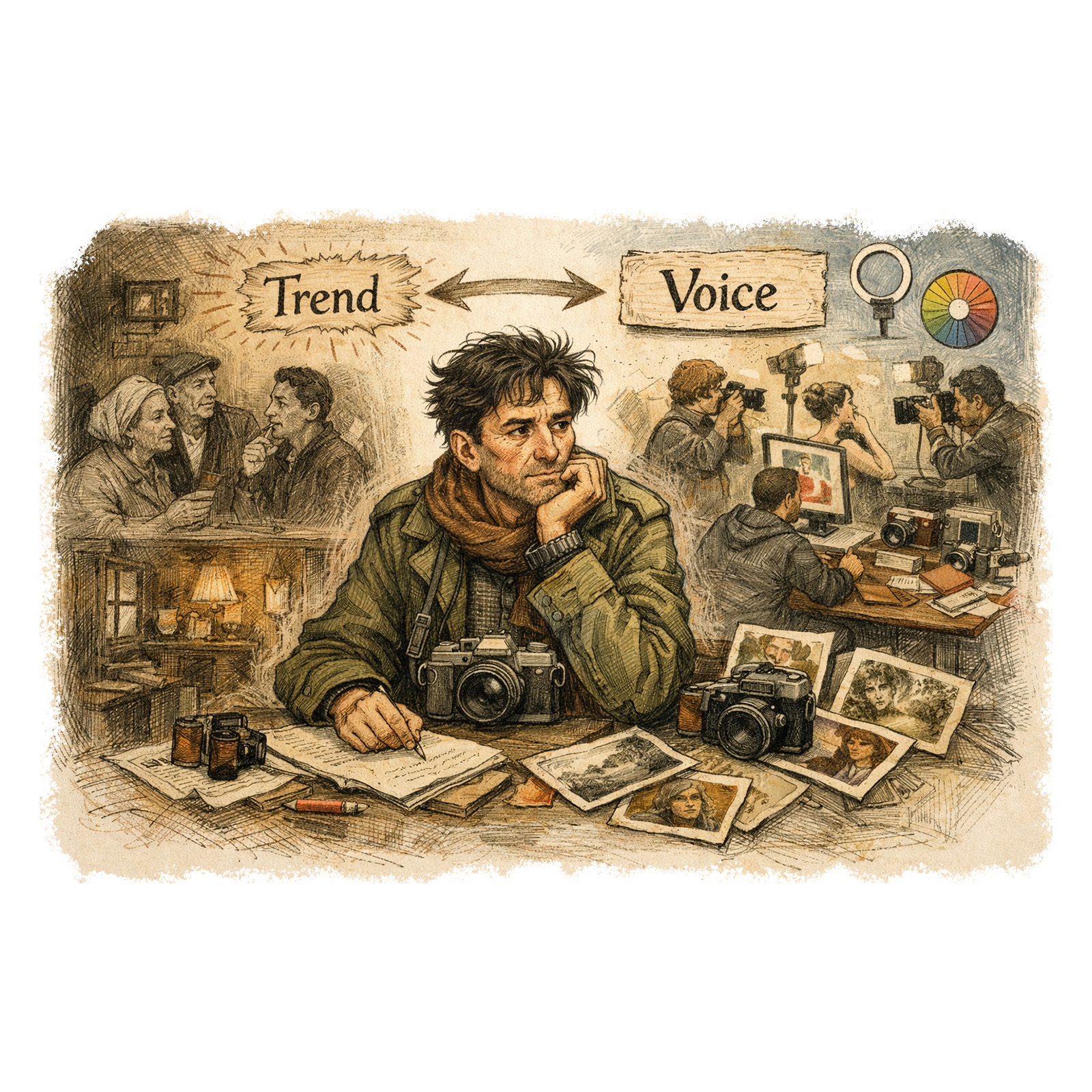
There’s a moment in every creative career where you look at your own work and think:
“Should it look more like that?”
That question sounds harmless.
Curious, even.
But it can quietly pull you off course.
When I started photography, it wasn’t because I’d analysed market trends. It wasn’t because I’d studied what was popular. It wasn’t because I’d reverse-engineered an algorithm.
It was because I wanted to tell stories.
Real ones.
Unpolished ones.
Conversations that didn’t fit neatly into headlines. Faces that carried history. Rooms that held tension and tenderness at the same time.
That instinct came from lived experience. From seeing how easily people are summarised. From understanding that nuance matters.
But the industry doesn’t always reward nuance immediately.
The industry rewards visibility.
And visibility often follows trends.
Muted tones become popular.
Then warm, cinematic edits.
Then high-contrast flash.
Then ultra-clean minimalism.
Then documentary chaos.
Then editorial stiffness.
Trends cycle faster than seasons.
And if you spend enough time online, it’s impossible not to notice.
You open social media and suddenly everyone’s shooting with direct flash. Or everyone’s underexposing slightly. Or everyone’s embracing heavy grain and nostalgic colour shifts.
And there’s a subtle pressure that creeps in:
Maybe I should be doing that too.
Not because it resonates deeply.
But because it’s everywhere.
I’ve felt it.
That quiet doubt when your work doesn’t visually align with what’s trending.
You start questioning your palette.
Your framing.
Your approach.
You think, “Is mine outdated? Am I missing something?”
There’s a difference between evolving and chasing.
Evolution is internal.
Chasing is reactive.
I once bought a piece of equipment specifically because it was “the look.”
Not because I loved the aesthetic.
Not because it aligned with my documentary instinct.
Because it was trending.
I told myself it was strategic.
Expanding my toolkit.
Diversifying my style.
Staying relevant.
If I’m honest, I secretly didn’t even like the look that much.
But relevance is persuasive.
There’s something uncomfortable about not matching the industry mood.
Especially when you’ve built your career steadily and don’t want to drift into invisibility.
The problem is, chasing trends creates a creative disconnect.
You end up producing work that technically fits the moment but doesn’t feel fully yours.
You post it.
It performs reasonably.
But something feels off.
It doesn’t sit naturally.
That’s the emotional core of the trend trap.
Not failure.
Disconnection.
The image might be sharp. Stylish. Contemporary.
But it doesn’t feel rooted.
And when your roots are in social documentary — in honesty, in story, in human nuance — superficial alignment starts to grate.
There were moments where I’d look at a feed curated around trends and think, “That’s clever.”
And then I’d look at my own work and think, “This is different.”
Different can feel risky.
Different can feel like you’re missing the wave.
The industry often celebrates those who ride waves early.
And that’s fine.
But if you’re not careful, you start reshaping your voice to fit external noise.
Noise is loud.
Voice is steady.
When I was deep in community projects, listening to people talk about lived experiences, documenting realities that weren’t glamorous, the last thing on my mind was whether the colour grade matched the algorithm’s preference.
But then I’d step back online and see stylised, hyper-curated feeds dominating attention.
And I’d wonder if raw honesty was enough.
That’s the trap.
You begin to dilute your voice not because it lacks depth, but because it lacks trend alignment.
There’s a specific discomfort in feeling out of sync with the industry.
You worry you’ll be left behind.
Left behind by what, exactly?
Aesthetic cycles.
But aesthetic cycles are temporary.
Voice, if cultivated properly, compounds.
I had to make a decision at one point.
Do I want to be recognisable?
Or do I want to be relevant?
They’re not always the same thing.
Relevance is often short-term.
Recognition builds slowly.
When someone sees your work and knows it’s yours without reading the caption — that’s voice.
That doesn’t happen by copying.
It happens by consistency.
Chasing trends is exhausting.
Every six months, something shifts.
Lighting styles change.
Editing styles change.
Compositional preferences evolve.
If you anchor your identity to trends, you will constantly be adjusting.
Constantly catching up.
Constantly slightly off.
And here’s the subtle irony: the photographers who seem effortlessly relevant often have a strong core voice underneath.
They might adopt elements of a trend, but they filter it through something stable.
Without that core, you become a mirror.
Reflecting whatever is loudest at the moment.
I’ve learned to pause before adapting.
When I notice something trending, I ask:
Do I actually like this?
Does it serve my way of seeing?
Would I still use this if it wasn’t popular?
If the answer is no, I let it pass.
That’s not stubbornness.
It’s alignment.
There’s freedom in realising you don’t need to ride every wave.
Your audience isn’t necessarily the entire industry.
It’s the people who resonate with your way of seeing.
When I leaned back into my documentary roots — into patience, into emotional honesty, into images that breathe rather than shout — something settled.
The work felt coherent again.
It felt like mine.
And interestingly, the response deepened.
Not necessarily louder.
But stronger.
Because authenticity travels further than imitation over time.
Trends spike.
Voice compounds.
There’s nothing wrong with evolution.
Growth requires it.
But evolution should feel like extension, not disguise.
When you buy equipment for a trend you secretly dislike, when you edit in a style that doesn’t sit comfortably, when you frame moments in ways that feel performative rather than intuitive, you know.
You feel it.
And that feeling matters.
Creative disconnect isn’t dramatic.
It’s subtle dissatisfaction.
You deliver the image and think, “Technically good. Emotionally distant.”
That’s the cost of chasing.
When your work is rooted in lived experience, in empathy, in nuance, trend alignment becomes secondary.
The people who trust you don’t choose you because you match an aesthetic wave.
They choose you because they trust your perspective.
Perspective takes time.
It’s built through repetition.
Through saying no to certain directions.
Through refining what feels natural.
Authentic voice compounds over time.
It strengthens with each aligned decision.
It deepens with each project completed in your own way.
It becomes recognisable not because it’s fashionable, but because it’s consistent.
I still notice trends.
Of course I do.
I’d be lying if I said I didn’t occasionally think, “That’s interesting.”
But now I filter them.
Not through fear of missing out.
Through clarity of intention.
Does this add to my voice?
Or does it blur it?
If it blurs it, it’s not for me.
Relevance fades.
Voice remains.
And I’d rather build something that remains.
Even if it grows slower.
Even if it doesn’t spike overnight.
Because in the long game, authenticity wins quietly.
And quiet wins still count.
How to find this article: