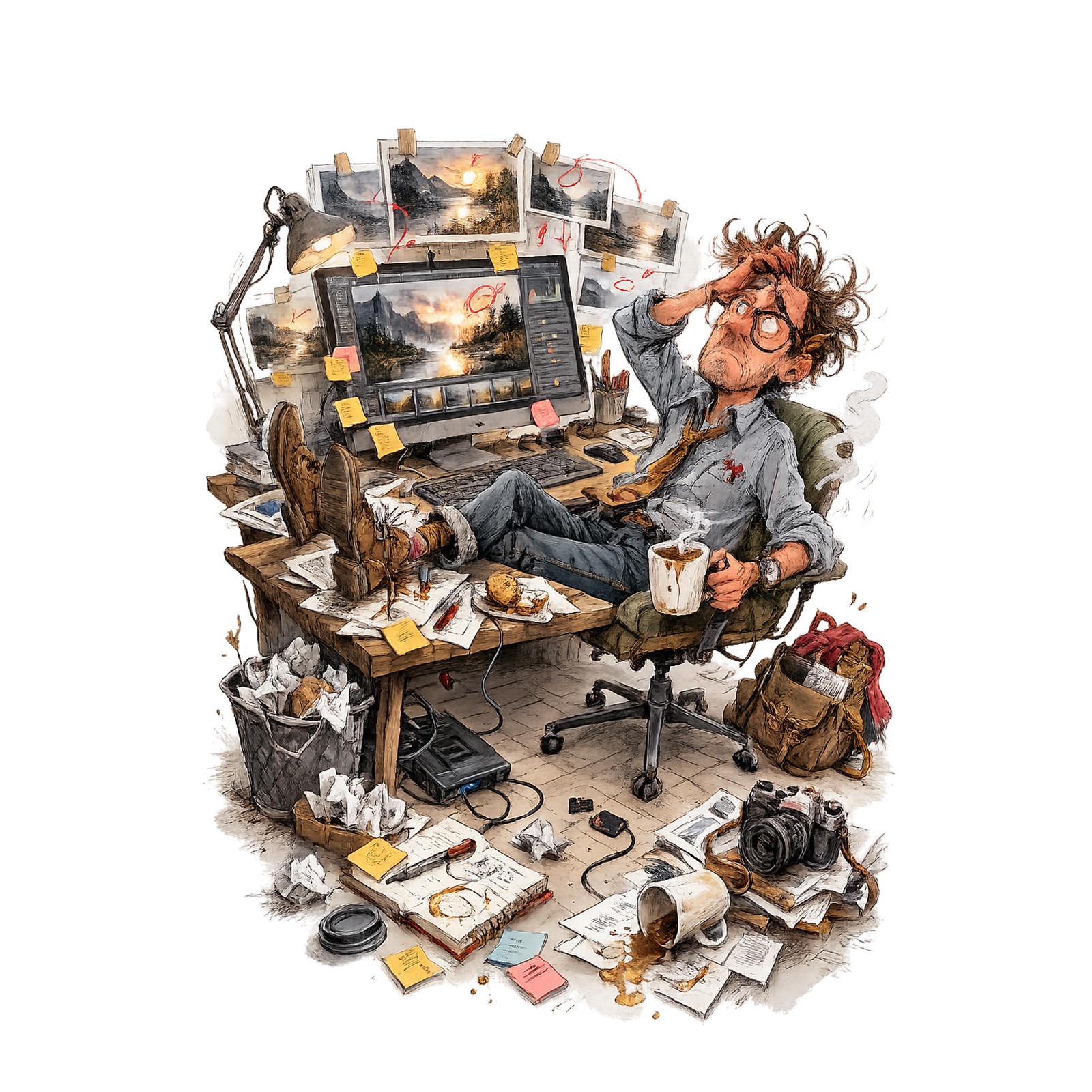
There is a very specific kind of madness that happens when you decide something you create must not only be good — it must be undeniable.
Not solid.
Not honest.
Not meaningful.
Undeniable.
The kind of work that makes critics nod quietly and say, “Yes, that’s professional.” The kind that leaves no room for someone to say, “Hmm.”
Because “hmm” feels dangerous.
I have re-edited the same image seventeen times.
Seventeen.
I counted once.
Adjusted exposure.
Tweaked contrast.
Pulled the highlights back.
Pushed them forward again.
Adjusted skin tones by a fraction.
Stepped away.
Came back.
Zoomed in.
Zoomed out.
At some point, you’re no longer refining.
You’re defending.
Perfectionism is often dressed up as high standards.
It sounds admirable.
“I just care about quality.”
“I don’t like putting out work that isn’t right.”
And yes, quality matters.
But there’s a difference between care and fear.
For me, perfectionism wasn’t about excellence.
It was about protection.
When you’ve been underestimated earlier in life, when people have looked at you and quietly assumed you wouldn’t amount to much, something shifts.
You start trying to eliminate doubt before it appears.
You want to produce work so solid that no one can dismiss you.
No one can say, “See? I knew it.”
I didn’t grow up in an environment where creative careers were mapped out neatly. I didn’t follow a linear path. There were seasons where stability was fragile and direction was unclear.
When you rebuild from that, you become hyper-aware of perception.
You don’t want to give anyone a reason to question your legitimacy.
So you overcorrect.
You polish.
You refine.
You edit one image seventeen times.
Because if it’s flawless, no one can argue.
That’s the theory.
The reality is different.
Perfectionism doesn’t eliminate criticism.
It delays completion.
It slows momentum.
It steals joy.
There were projects I sat on longer than necessary because I wanted them to be airtight.
Exhibitions that could have been ready sooner.
Images that were already strong enough but lived in Lightroom purgatory because I wasn’t quite satisfied.
Satisfied with what, exactly?
Sometimes I couldn’t even articulate it.
Just… not quite.
That “not quite” is perfectionism’s favourite phrase.
It’s vague enough to keep you working indefinitely.
There’s a subtle fear behind it.
Fear of being publicly wrong.
When you put work out into the world, you risk reaction.
You risk disagreement.
You risk indifference.
And indifference, if I’m honest, scares me more than criticism.
Because criticism at least acknowledges presence.
Indifference feels like invisibility.
If I think back carefully, the fear of being average isn’t about ranking.
It’s about being overlooked.
About blending in.
About someone glancing at your work and moving on without a second thought.
That’s where perfectionism tightens its grip.
You think, If I just push this a bit further, it will stand out.
But pushing endlessly doesn’t always elevate.
Sometimes it flattens.
I’ve noticed something about my editing habits.
The first version is often strong.
Natural.
Instinctive.
Then I start “improving” it.
Smoothing.
Balancing.
Tweaking.
And occasionally, I edit the life out of it.
Not because I lack skill.
Because I lack trust.
Trust in my eye.
Trust in my judgement.
Trust that what felt right initially was right enough.
Perfectionism convinces you that the first instinct is naive.
That professionals deliberate endlessly.
That real creatives obsess over minutiae.
There’s some truth in that — attention to detail matters.
But attention driven by fear looks different from attention driven by craft.
Fear-driven perfectionism sounds like this:
What if someone spots a flaw?
What if someone questions this decision?
What if I look foolish?
Craft-driven refinement sounds like:
Does this serve the story?
Is this honest?
Is this intentional?
One is defensive.
The other is purposeful.
I’ve spent evenings hunched over a screen adjusting shadows by microscopic amounts, telling myself this was dedication.
In reality, it was hesitation.
If I don’t export it, I can’t be judged.
If I don’t publish it, no one can disagree.
If I don’t finish it, it remains potential.
Potential is safe.
Finished work is vulnerable.
There’s something deeply exposing about completion.
When you finish something, you’re saying, “This is what I believe.”
That’s risky.
Especially when earlier chapters of your life involved being underestimated.
Because part of you still carries that old narrative:
Don’t mess this up.
So you overprepare.
Overwork.
Over-polish.
There was a time when I’d delay posting work because I wanted the caption to be perfect too.
As if one slightly clumsy sentence would unravel the entire thing.
I laugh at it now.
But at the time, it felt serious.
Perfectionism rarely feels dramatic.
It feels responsible.
It whispers, “You’re just being thorough.”
But thoroughness doesn’t usually involve seventeen edits.
That’s fear wearing professionalism.
I had to confront something uncomfortable.
If I’m honest, I wasn’t afraid of being average.
I was afraid of confirming someone else’s doubt.
Some imagined critic.
Some past voice.
Some shadow of earlier underestimation.
The irony is that most people aren’t analysing your work with the intensity you analyse it yourself.
They’re responding emotionally.
They’re not zooming into pixel-level imperfections.
They’re experiencing the image.
The fear of being average makes you forget that.
It shifts your focus from connection to correction.
And connection is the point.
I began experimenting with something simple.
Deadlines.
Not client deadlines — I respect those religiously.
Self-imposed deadlines.
Edit once.
Refine once.
Export.
No infinite loop.
It felt reckless at first.
Almost irresponsible.
But something interesting happened.
The work didn’t collapse.
The images didn’t fall apart.
In fact, they often felt more alive.
Less overworked.
More honest.
Perfectionism as protection keeps you safe from embarrassment.
It does not guarantee excellence.
Excellence comes from clarity.
Clarity comes from experience.
Experience comes from doing.
And doing requires finishing.
There’s a quiet power in deciding something is done.
Not flawless.
Done.
Done means you stand behind it.
Done means you accept imperfection.
Done means you’re willing to be seen.
The shift for me wasn’t lowering standards.
It was redefining them.
Instead of asking, “Is this perfect?” I started asking, “Is this true?”
Is it aligned with what I intended?
Does it serve the story?
Does it reflect my eye?
If the answer is yes, it’s done.
Not because it couldn’t be tweaked further.
Because further tweaking doesn’t necessarily add value.
There’s a moment in every project where continued editing stops improving and starts stalling.
Learning to recognise that moment is maturity.
It’s also freedom.
The fear of being average softens when you realise something important.
Average isn’t the opposite of perfect.
Average is the opposite of engaged.
If you care deeply, if you show up consistently, if you refine with intention, you are not operating in the realm of average.
You are operating in growth.
And growth is messy.
It includes imperfect frames.
It includes experimental edits.
It includes work that might not land universally.
That’s fine.
Perfectionism tries to eliminate risk.
But risk is where connection lives.
The projects that have resonated most in my career weren’t technically flawless.
They were emotionally clear.
They were intentional.
They were finished.
Done beats perfect.
Not because standards don’t matter.
But because perfection is an illusion that keeps moving.
Done is real.
Done allows the next thing to begin.
And the next.
And the next.
If I had waited for perfection before publishing work, before exhibiting, before sharing stories, I’d still be editing the first folder from 2015.
Instead, I finished.
Repeatedly.
And in finishing, I built something.
Not perfect.
But solid.
And solid is far more sustainable than flawless.
How to find this article: