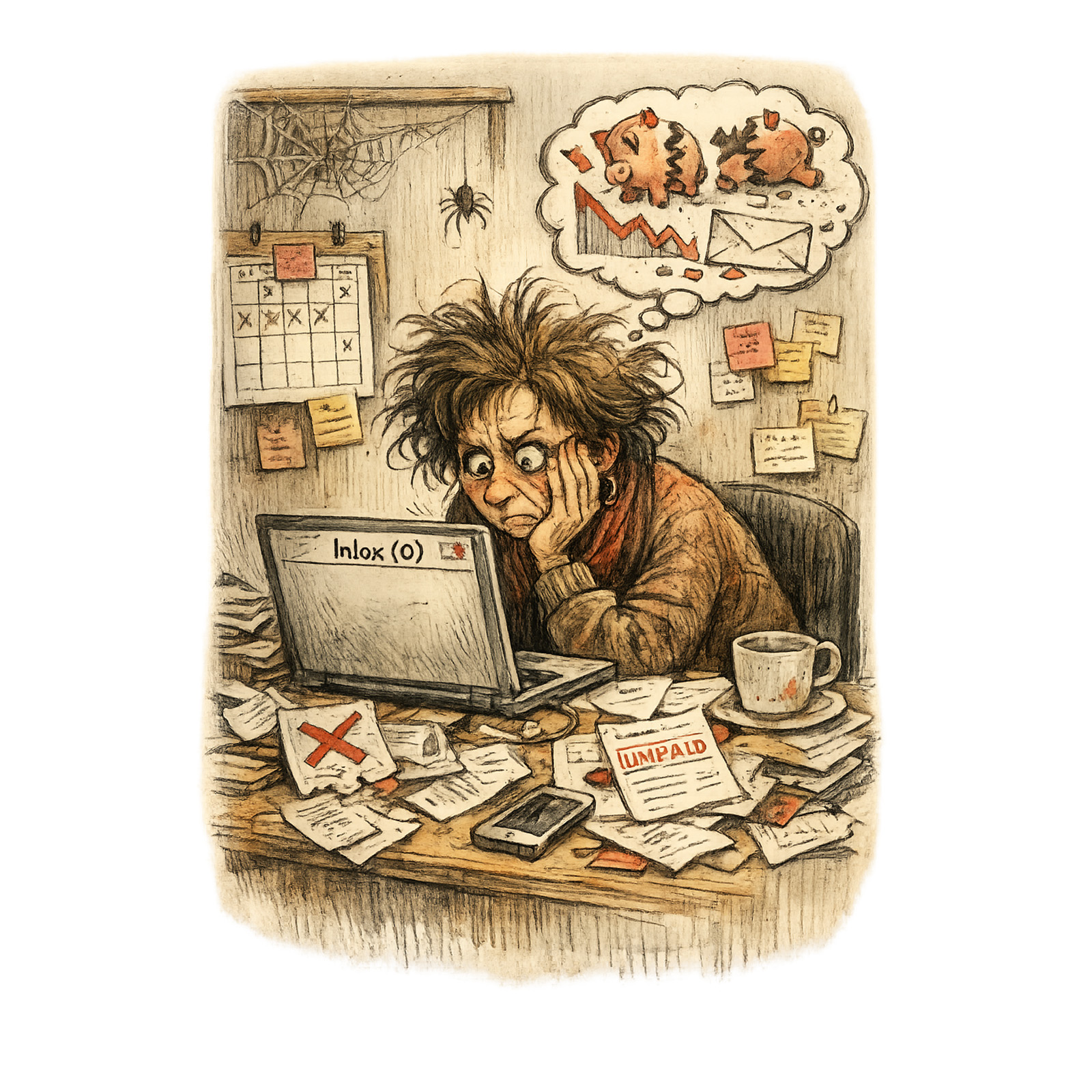
There is a particular type of silence that only self-employed people truly understand.
It’s not peaceful silence.
It’s inbox silence.
No new enquiries.
No booking confirmations.
No “We’d love to go ahead.”
Just newsletters you didn’t subscribe to and a receipt for something you forgot you bought.
On paper, it’s a slow week.
In your head, it’s the beginning of collapse.
I have checked my email like it personally owed me rent.
Refresh.
Nothing.
Refresh.
Still nothing.
Refresh again, as if the act of staring harder will summon a bride, a charity, or an organisation out of thin air.
It would be funny if it didn’t feel so real in the moment.
The thing about quiet months is this: for some people, they’re mildly inconvenient.
For others, they hit something older.
For me, slow periods in business don’t just trigger professional concern.
They trigger memory.
Memory of instability.
Memory of not knowing where you’ll be in a month.
Memory of uncertainty stretching out longer than expected.
When you’ve lived through financial instability, even temporarily, your nervous system doesn’t forget.
It learns.
It scans for threat.
So when the calendar looks thin, the reaction isn’t calm analysis.
It’s alarm.
Not loud.
But persistent.
Is this the start of something?
Have you missed something?
Are you slipping?
Business anxiety and survival instinct look very similar from the inside.
They both whisper urgency.
They both tell you to act quickly.
They both assume worst-case scenarios.
There’s a difference between strategic awareness and panic.
But when your history includes seasons of genuine instability, that difference blurs.
I remember one particular month where bookings slowed noticeably.
Nothing dramatic. No mass cancellations. Just a dip.
And my brain did what brains do when left unattended.
It started building stories.
You’ve peaked.
People have moved on.
You’re not as relevant.
This is the beginning of the slide.
All based on a few quiet weeks.
Objectively, I knew that business ebbs and flows. Weddings are seasonal. Projects have gaps. People plan months in advance.
Subjectively, my chest felt tight.
There’s something about uncertainty that magnifies when you’ve felt it deeply before.
When you’ve once counted coins carefully. When you’ve once felt days stretch without structure. When you’ve once lived in a space that wasn’t quite yours.
Slow business feels louder.
It doesn’t just feel like, “Oh, this month’s quiet.”
It feels like, “Are we back there?”
That’s the emotional core of calendar panic.
Not greed.
Not ambition.
Fear of slipping backwards.
Backward doesn’t have to mean disaster.
It just means instability.
And instability, once experienced, leaves an imprint.
The rational part of me understands cash flow.
Understands marketing cycles.
Understands that long-term projects create irregular income patterns.
But the older part — the one shaped by less secure seasons — reacts first.
Refresh the inbox.
Check the calendar.
Recalculate projections.
Consider lowering prices.
Consider saying yes to everything.
It’s fascinating how quickly fear tries to shrink your standards.
You move from confident to reactive in minutes.
I’ve had moments where I’ve opened my booking system and stared at empty weekends like they were accusations.
Why are you blank?
What did I miss?
Should I be doing more?
Calendar panic convinces you that blank space equals failure.
It doesn’t account for rhythm.
It doesn’t account for seasonality.
It certainly doesn’t account for the fact that businesses are not linear escalators.
They’re waves.
The comedy of it, when I look back, is how dramatic my internal dialogue can become over relatively small fluctuations.
A quiet fortnight and I’m mentally drafting contingency plans worthy of a government department.
I once caught myself calculating worst-case scenarios after three slow days.
Three days.
That’s not analysis.
That’s trauma with spreadsheets.
I don’t use that word lightly.
I’m not suggesting every slow booking week is traumatic.
But I am acknowledging that past instability wires your system differently.
Your threshold for “this is fine” lowers.
Your response time to perceived threat shortens.
The problem is, if you let that instinct run unchecked, it pushes you into decisions rooted in fear rather than strategy.
Dropping prices impulsively.
Overcommitting to low-value work.
Saying yes when you should pause.
I’ve done all three at different points.
Because in the moment, security feels more important than alignment.
You think, “Better busy than quiet.”
But busy at the wrong level can burn you out and still not solve the underlying anxiety.
There was a turning point for me.
A quiet month that lasted just long enough for me to notice my pattern clearly.
The refresh.
The projection.
The mental spiralling.
And then something slightly unexpected happened.
Work came in.
Not dramatically. Not all at once.
Just steadily.
Enquiries that had been in conversation.
Projects that were delayed but not cancelled.
Bookings that had always been on a different timeline than I’d imagined.
Nothing had actually collapsed.
The silence had just been a pause.
That’s when I started asking a more helpful question:
Is this a business fluctuation or a personal trigger?
It’s an uncomfortable distinction.
Because sometimes it’s both.
Yes, you should pay attention to your numbers.
Yes, you should be proactive about marketing.
Yes, you should evaluate patterns.
But not every quiet period is a warning sign.
Sometimes it’s just a quiet period.
The deeper shift came when I realised something simple:
Today’s quiet month is not yesterday’s crisis.
My circumstances are different.
My stability is different.
My network is different.
My experience is different.
I am not operating from zero anymore.
Calendar panic assumes you are.
It collapses time.
It makes your current position feel as fragile as your earliest one.
But they are not the same.
I have data now.
I have past performance.
I have repeat clients.
I have partnerships.
Those things matter.
They are structural.
Fear doesn’t always acknowledge structure.
It responds to sensation.
And the sensation of silence can feel heavy.
I’ve had to build practices around this.
Not dramatic ones.
Simple ones.
Instead of refreshing email obsessively, I schedule check-ins.
Instead of catastrophising, I review actual trends.
Instead of reacting instantly, I wait.
Waiting is uncomfortable when your nervous system wants action.
But often, waiting reveals that nothing is wrong.
The calendar fills in its own time.
One of the quiet ironies of self-employment is that the seasons where you’re most anxious about bookings are often the seasons where you need to focus on the work already in front of you.
Editing.
Planning.
Refining.
Developing.
Calendar panic steals attention from present tasks.
It projects you into a future that hasn’t arrived.
I still feel it occasionally.
A thin-looking month.
An unexpected cancellation.
A slower enquiry rate.
The first flicker is still there.
But now I recognise it.
I don’t let it run unchecked.
I remind myself:
You’ve been through actual instability.
This is not that.
This is business rhythm.
That distinction is powerful.
Because fear rooted in memory needs reassurance rooted in evidence.
Evidence that you are not where you once were.
Evidence that your foundation is stronger.
Evidence that one quiet stretch does not undo years of steady building.
Calendar panic thrives on isolation too.
It grows louder when you sit alone with your projections.
Conversations help.
With peers.
With mentors.
With anyone who has run a business long enough to understand fluctuation.
You quickly realise that quiet months are not personal failures.
They are normal.
But normal doesn’t always feel normal when your history includes genuine scarcity.
The ultimate shift for me was this:
I stopped treating blank spaces on the calendar as accusations.
I started treating them as capacity.
Capacity to refine systems.
Capacity to rest strategically.
Capacity to develop new ideas.
Blank space is not emptiness.
It’s potential.
That sounds almost poetic, but it’s practical.
The month that looks quiet in advance often fills partially.
And the space that remains can either be filled with panic or with intention.
Today’s quiet month is not yesterday’s crisis.
It’s a season.
And seasons change.
The man who once feared instability reacts quickly.
The professional who has built steadily responds calmly.
Both live in me.
But only one gets to make decisions now.
And that difference makes all the difference.
How to find this article: