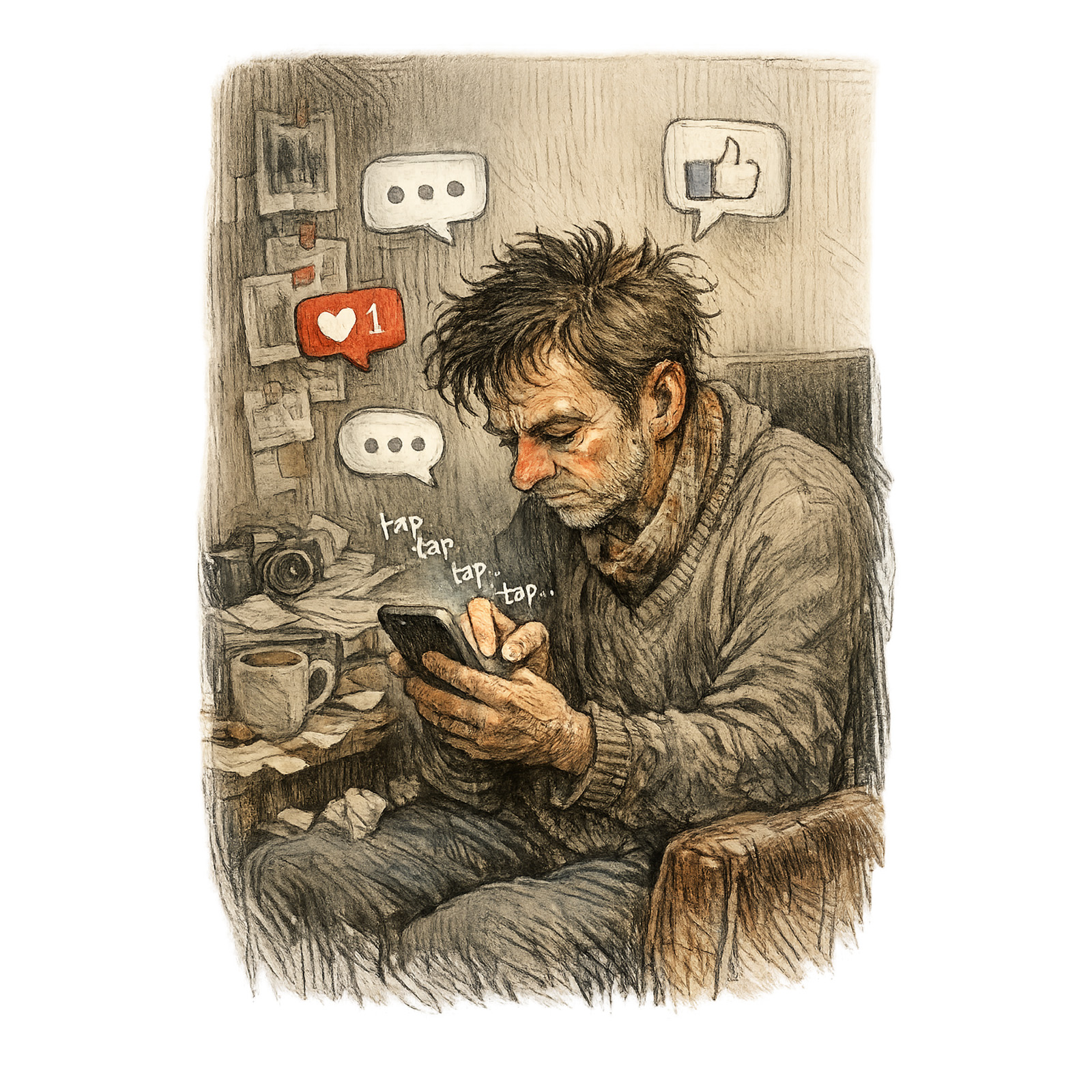
There is a very specific sound I’ve grown familiar with.
It isn’t a camera shutter.
It isn’t applause in a cathedral.
It isn’t even someone saying, “This changed how I see things.”
It’s the soft, slightly embarrassing tap of my thumb refreshing a screen.
Again.
And again.
And again.
If you want an honest confession, here it is: validation is addictive.
Not in a dramatic, rock-bottom kind of way. In a subtle, socially acceptable kind of way. The kind where you convince yourself you’re “just checking engagement.”
After you’ve rebuilt your life from a place that felt unstable, recognition hits differently.
When you’ve come through uncertainty, when you’ve had seasons where you didn’t feel visible or secure, applause feels like oxygen.
It feels like proof.
Proof that you’re not invisible.
Proof that you didn’t imagine the progress.
Proof that the work matters.
The first time one of my exhibitions drew serious numbers — proper footfall, steady streams of people, conversations happening in front of images I had taken — I was genuinely moved.
Not performatively moved.
Quietly.
Watching strangers pause in front of something you created does something to your nervous system.
It says, “You’re here.”
When the High Sheriff commissions came in — official emails, formal language, real responsibility — that sense of legitimacy deepened.
This wasn’t just a hobby.
This wasn’t just someone giving me a chance out of kindness.
This was trust.
Trust in my ability to tell stories.
Trust in my judgement.
Trust in my work.
And trust, when you’ve had periods of instability, feels sacred.
So when applause came — whether in physical rooms or digital ones — I welcomed it.
Of course I did.
Who wouldn’t?
The problem isn’t enjoying applause.
The problem is relying on it.
There’s a subtle shift that happens.
You post something meaningful.
It lands well.
People respond.
Your phone lights up.
You feel seen.
You feel affirmed.
You feel like you’re moving forward.
And then, the next post doesn’t land quite as loudly.
Fewer comments.
Fewer shares.
A slower trickle of likes.
And suddenly your internal dialogue shifts.
Was the last one a fluke?
Did I lose momentum?
Am I slipping?
It’s ridiculous when you say it out loud.
But in the quiet of your own head, it feels legitimate.
I have refreshed Instagram likes like they were a heart monitor.
There. I said it.
Posted something.
Watched the numbers tick up.
Closed the app.
Reopened it three minutes later as if the algorithm might have dramatically shifted in that time.
It’s faintly tragic when you describe it honestly.
A grown man checking engagement metrics like he’s monitoring vital signs.
But here’s the uncomfortable truth: when recognition has helped you rebuild your confidence, it starts to feel necessary.
Not just nice.
Necessary.
When you’ve rebuilt your life piece by piece, external affirmation can feel like reinforcement of that rebuild.
It says, “You’re not imagining it. You’ve actually done something.”
That’s powerful.
And powerful things can become addictive.
The emotional high of an exhibition opening is intense.
People shaking your hand.
Kind words.
Questions about process.
Photographs being discussed seriously.
You leave that space buoyant.
Charged.
Certain.
And then the next morning, you’re back at your desk.
The house is quiet.
The inbox looks ordinary.
The kettle boils like it always does.
The high fades faster than expected.
That’s the part nobody prepares you for.
You assume that reaching milestones will permanently elevate your confidence.
They don’t.
They spike it.
Then it settles back down.
The danger is mistaking the spike for the baseline.
If you start believing that the applause is the measure of your worth, you will constantly chase louder rooms.
Bigger exhibitions.
More visible commissions.
Higher engagement.
Because the previous level stops feeling sufficient.
I noticed this pattern slowly.
An exhibition would go well. I’d feel grateful. Energised.
Then, almost immediately, my mind would jump ahead.
What’s next?
How do I top this?
How do I maintain this momentum?
Momentum.
That word sounds productive. Ambitious.
But sometimes it’s just fear of silence.
Silence can feel like regression.
No notifications.
No public praise.
No visible validation.
When you’ve had seasons of invisibility in your life, silence can echo.
I had to sit with that.
Why does silence bother you so much?
The answer wasn’t glamorous.
Because visibility feels safer than invisibility.
Applause feels like security.
If people are watching, approving, engaging — you must be doing okay.
If they’re quiet, maybe something’s wrong.
That’s the flawed logic.
The work doesn’t change based on the noise around it.
But your perception does.
There was a moment after one significant project where the response was strong. Conversations were happening beyond the exhibition space. Feedback was thoughtful. Numbers were solid.
And I remember thinking, “Right. This is it. This is the level.”
A week later, normal life resumed.
No dramatic decline. Just ordinary rhythm.
And I felt slightly deflated.
Not because anything had gone wrong.
Because nothing was happening loudly.
That’s when I realised I’d subtly started leaning on applause as confirmation of progress.
And applause is unstable.
It depends on timing.
On platform.
On attention spans.
On algorithms.
On whether people happen to be online that day.
It is not a stable foundation.
Fuel, yes.
Foundation, no.
Fuel gives you a boost.
Foundation holds you up when nothing is clapping.
The deeper work — the steady, consistent, often quiet work — doesn’t always receive applause.
A careful conversation with someone sharing their story doesn’t trend.
A thoughtful edit session at 11pm doesn’t get likes.
The months of preparation before a public moment aren’t visible.
If you build your sense of worth on visible moments alone, you ignore the majority of your own effort.
And that’s dangerous.
I had to learn to separate response from reality.
Response is how loudly something lands.
Reality is whether it was meaningful.
Some of the most important conversations I’ve had around my work have happened quietly.
No cameras.
No announcements.
No social posts.
Just someone saying, “That meant something to me.”
Those moments don’t trend.
But they matter.
I still enjoy applause.
Let’s not pretend I’ve transcended humanity.
I still smile when engagement is strong. I still feel encouraged when projects are recognised.
But I no longer treat those spikes as proof of identity.
Because identity built on applause will wobble when the room goes quiet.
And rooms always go quiet eventually.
The healthier shift was this:
Applause is feedback.
Not definition.
It tells you something landed.
It doesn’t tell you who you are.
Who you are is shaped by repetition.
By showing up when no one is watching.
By doing the work when there’s no audience.
If I had built my confidence solely on exhibitions and commissions, it would have collapsed in quieter seasons.
Instead, I learned — slowly — to root it in something steadier.
Process.
Discipline.
Purpose.
When you’ve rebuilt your life once, you learn something important.
External circumstances can change quickly.
Stability cannot depend entirely on what’s happening outside you.
The same applies creatively.
Applause is powerful.
It’s affirming.
It’s energising.
But it’s not structural.
It’s fuel.
Fuel gets you moving.
Foundation keeps you standing.
And if you’re honest, the most sustainable careers aren’t built by those who chase the loudest applause.
They’re built by those who keep working when the room is silent.
I still occasionally refresh a post more times than necessary.
Old habits.
But now, when I catch myself doing it, I smile.
Because I recognise what I’m seeking.
Not likes.
Reassurance.
And reassurance doesn’t live in metrics.
It lives in the work itself.
The projects completed.
The stories told.
The consistency maintained.
Applause is welcome.
But it doesn’t get to hold the structure up.
That part is built elsewhere.
Quietly.
Steadily.
Without the need for clapping.
How to find this article: