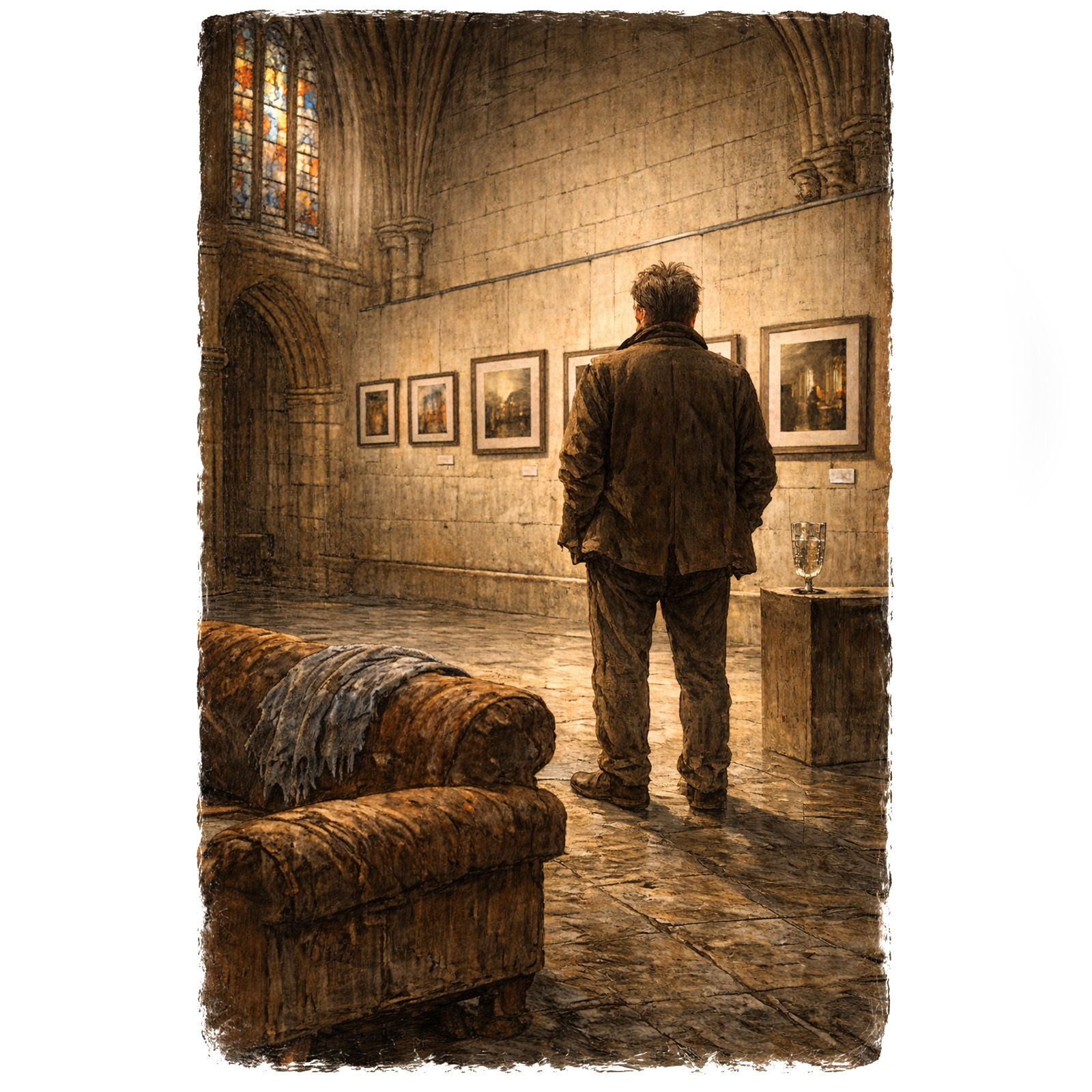
There are rooms I walk into now that still feel slightly illegal.
Not illegal in the criminal sense. More in the “are you sure you’re meant to be here?” sense.
Cathedrals.
Private viewings.
Gallery openings where the wine glasses are thinner than my confidence.
I’ve stood in some beautiful spaces over the last few years. High ceilings. Stone arches. Proper lighting. My work framed and hanging on walls that have been standing longer than my entire family line.
And every so often, while someone is saying something kind about the project, my brain drifts.
Not to the next shoot.
Not to the editing queue.
But backwards.
To sofas.
To borrowed duvets.
To that slightly awkward feeling of not fully unpacking because you’re not entirely sure how long you’re staying.
For two years, life was unstable in a way that doesn’t always make headlines. Not dramatic cardboard-box imagery. Just quiet, grinding uncertainty. Housing that wasn’t really yours. Time that didn’t feel anchored. Days that stretched out without structure.
You become very aware of space when you don’t quite have your own.
You notice where you’re allowed to sit.
Where you’re allowed to leave things.
How much noise you’re allowed to make.
That kind of awareness stays with you.
So when I stand in a cathedral now, looking at photographs I took, surrounded by people who have chosen to come and see them, there’s always a small part of me thinking:
They have no idea.
No idea that a few years ago, stability was a luxury.
No idea that routine felt like a distant concept.
No idea that the man holding the glass of sparkling water once counted the days by where he might sleep next.
It’s not shame.
It’s contrast.
The contrast can feel surreal.
I remember one particular private viewing. Proper event. Invitations. Printed programmes. People dressed well. Someone introduced me with a title that sounded far more polished than I felt.
“Christopher is the photographer behind this project…”
Behind.
That word landed.
Behind suggests intention. Vision. Leadership.
I stood there nodding, smiling politely, while a very different memory played quietly in the background. A living room. A sofa that wasn’t mine. The careful folding of a blanket each morning so I didn’t overstep.
It’s strange how the body remembers environments.
Even now, in polished spaces, I instinctively check where I’m standing. Am I blocking someone? Am I in the way?
Housing instability teaches you to minimise yourself.
Not dramatically. Subtly.
You learn to shrink your footprint.
To not assume permanence.
To avoid leaving marks.
And then, years later, you’re invited to leave a mark on a cathedral wall.
It does something to your sense of identity.
The challenge isn’t success.
The challenge is carrying the old version of yourself into the new room without letting him run the show.
Because the old version is cautious.
He says, “Don’t get too comfortable.”
He says, “This might not last.”
He says, “Be grateful, but don’t assume.”
Gratitude is healthy.
But permanent caution can become a cage.
There were times early on when opportunities came my way and my first reaction wasn’t excitement.
It was suspicion.
Are you sure you mean me?
When organisations trusted me with stories — sensitive stories — there was that quiet internal double-check.
You’re aware I didn’t come through the traditional route, right?
When exhibitions were offered in significant spaces, part of me wanted to ask for confirmation twice.
Not because I doubted the work.
Because I doubted the room.
There’s a difference.
When you’ve experienced instability, stability can feel temporary even when it isn’t.
You expect the tap on the shoulder.
“Sorry, small mix-up. This isn’t actually yours.”
It never comes.
But the expectation lingers.
That’s the odd thing about carrying old identity into new rooms. Nobody else sees it. It’s internal.
People see the photographer.
You see the man who once packed a bag quietly in the morning.
I’ve had conversations at events where people assume I’ve always done this.
“How long have you been in the industry?”
It’s a normal question.
But I sometimes want to answer differently.
Not with dates.
With chapters.
There’s the before chapter.
The unstable chapter.
The rebuild chapter.
The camera chapter.
Instead, I give the simple answer.
And I smile.
Because I don’t need every room to know my full history.
But I do need to know it myself.
For a long time, I thought the goal was to outgrow that part of my life. To move so far forward that it became irrelevant.
What I’ve realised is that it’s not irrelevant.
It’s context.
Context explains why I value stability so fiercely.
Why quiet months can still rattle me.
Why I work hard, sometimes too hard.
Why I care about telling stories that often go unheard.
If you’ve felt invisible, you don’t take visibility lightly.
If you’ve felt unstable, you don’t treat stability casually.
Standing in cathedrals isn’t just professional pride. It’s perspective.
There was a moment — I remember it clearly — when I was standing alone in an exhibition space before it opened. Just me and the work.
The room was empty. Quiet. Light filtering through stained glass.
I walked along the wall, looking at each framed photograph.
And I thought about sofas.
About how far apart those two environments were.
Not geographically.
Existentially.
It wasn’t dramatic. I didn’t cry. I didn’t have a cinematic monologue.
I just stood there and thought, This is unusual.
Unusual in the best way.
And then I caught myself doing something I used to do years earlier — mentally preparing for loss.
Don’t get attached.
Don’t assume this lasts.
Stay cautious.
That voice isn’t evil. It kept me safe once.
But it doesn’t get to lead anymore.
Because here’s the shift.
Your past is context, not a cage.
Context explains your reactions.
A cage limits your movement.
For a while, I treated my past like something I had to compensate for. Something I had to outrun. Something that disqualified me from certain rooms.
What I’ve learned is that it does the opposite.
It sharpens awareness.
It deepens empathy.
It keeps arrogance in check.
When someone shares their story with me — particularly stories of instability, struggle, or systems that failed them — I don’t approach it academically.
I approach it with recognition.
Not identical experience. Not comparison.
Recognition.
And that matters.
The man who used to sleep on sofas walks into every exhibition with me.
But he doesn’t stand at the front anymore.
He stands slightly behind.
Observing.
Reminding.
Not warning.
There’s a difference between remembering and reliving.
Remembering gives you perspective.
Reliving traps you in reaction.
If I had stayed trapped in that earlier identity, I would never have walked into half the rooms I’ve been invited into.
I would have self-disqualified.
I would have said, “That’s not really for someone like me.”
But the truth is, rooms don’t check your backstory.
They respond to your work.
And the work was built after the instability, not before.
That matters.
Sometimes at events, when someone says something kind about the impact of a project, I still have that quiet internal thought:
They have no idea.
But now it’s less about disbelief.
It’s about gratitude.
Because the gap between the sofa and the cathedral isn’t accidental.
It’s built through repetition. Through showing up. Through not quitting when it would have been easier to shrink.
There’s a danger in romanticising struggle.
I’m not interested in that.
Housing instability isn’t a creative badge. It’s hard. It’s disorientating. It’s draining.
But surviving it gives you a certain clarity.
You stop taking rooms for granted.
You stop assuming permanence.
You stop confusing space with status.
When I stand in exhibition spaces now, I don’t feel like an imposter.
I feel aware.
Aware that life can change.
Aware that identity can shift.
Aware that the version of you that once felt small doesn’t define the whole story.
The man who used to sleep on sofas isn’t erased.
He’s integrated.
He reminds me not to waste stability.
Not to waste opportunity.
Not to waste time pretending I don’t belong.
Because belonging isn’t about origin.
It’s about contribution.
And contribution isn’t limited by your starting point.
Your past is context.
It explains your caution.
It explains your drive.
It explains your empathy.
But it doesn’t lock the door behind you.
The rooms I stand in now aren’t accidental.
They’re not charity.
They’re not mistakes.
They’re earned.
And the man who once counted nights on borrowed cushions?
He gets to stand in them too.
Not as an intruder.
As proof.
How to find this article: